Specification-driven feasibility and techno-economic assessment of recycling and valorization of HTV silicone rubber manufacturing scrap from composite insulator production
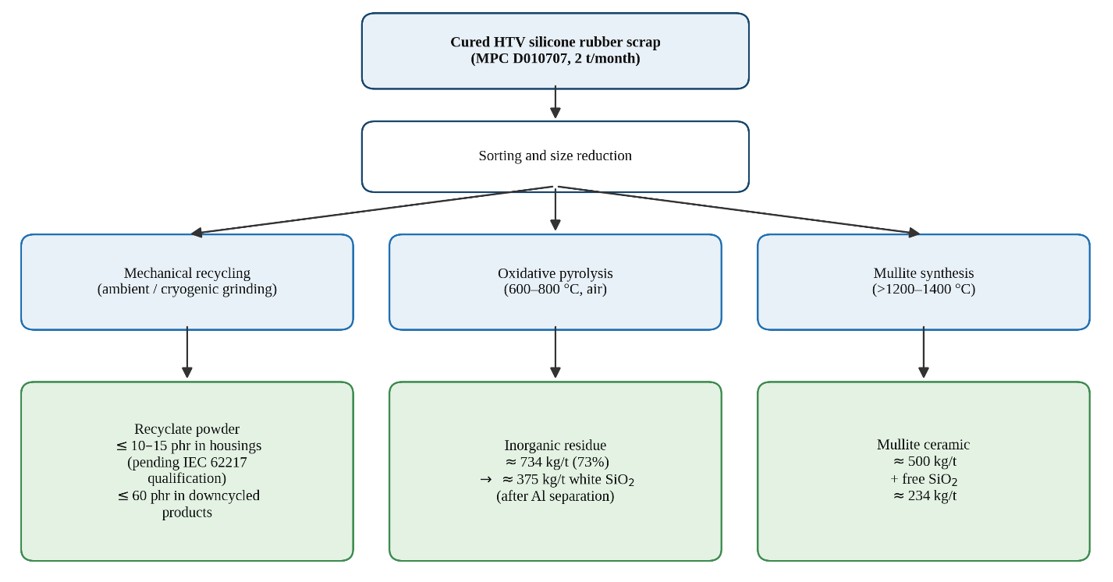
Composite silicone insulators are rapidly displacing ceramic and glass units in high-voltage transmission, and their manufacture generates substantial cured high-temperature-vulcanized (HTV) silicone rubber scrap that is chemically inert and non-degradable. This study presents a specification-driven feasibility and techno-economic assessment of recycling and valorizing 24 t/year (2 t/month) of cured HTV scrap (grade MPC D010707) generated in the production of 170 A/B, 170 C and 420 A/B composite insulators. Using the manufacturer quality specification together with the stoichiometry of aluminum trihydroxide (ATH) dehydration, a compositional model of approximately 55 wt% ATH, 5 wt% reinforcing silica, and 40 wt% polydimethylsiloxane (PDMS) is inferred without new laboratory characterization. Three valorization routes are modeled: mechanical recycling by ambient and cryogenic grinding with reincorporation into virgin compound; oxidative pyrolysis to recover a silica-rich inorganic residue; and high-temperature mullite synthesis. A linear property-degradation model, anchored to a recent peer-reviewed high-consistency rubber recyclate dataset, shows that mechanical property loss is not the binding constraint. Instead, the particle-size specification of 10 µm median diameter and the tracking and erosion requirement of class 1A4.5 restrict reincorporation into insulator housings to roughly 10 to 15 parts per hundred rubber (phr) until qualified by testing, whereas downcycled products tolerate up to 60 phr. Stoichiometric mass balances give a 73% inorganic yield for oxidative pyrolysis, of which 375 kg/ton is a high-value silica fraction, and 500 kg/ton mullite for the ceramic route. Techno-economic modeling identifies ambient mechanical recycling as the most attractive first investment, with a capital expenditure near USD 21,000 and a payback below one year, contingent on internal absorption capacity, with recovered-silica pyrolysis as a strategic second phase. The work is presented explicitly as a modeling and techno-economic feasibility study based on manufacturer specification data and literature-derived property models.
- Mordor Intelligence, "Composite insulators market size, share, 2025-2030 outlook", 2025. [Online]. Available: https://www.mordorintelligence.com/industry-reports/composite-insulators-market. [Accessed 23 Jul 2026].
- A. T. Wolf and A. Stammer, "Chemical recycling of silicones - current state of play (building and construction focus)," Polymers, vol. 16, no. 15, p. 2220, 2024. DOI: 10.3390/polym16152220.
- S. Yang, Y. Liu and D. Zhou, "Monomer recovery and nano-silica separation from biodegraded waste silicone rubber shed of composite insulator", Frontiers in Materials, vol. 9, p. 863731, 2022. DOI: 10.3389/fmats.2022.863731.
- R. Shang, L. Wang, F. Yin and M. Farzaneh, "Recycling of silicone rubber from composite insulator with pyrolysis method", CSEE Journal of Power and Energy Systems, vol. 10, no. 4, pp. 1787-1798, 2024. DOI: 10.17775/CSEEJPES.2022.05800.
- Z. Chen, L. Cheng, W Xu and R. Liao, "Preparation of highly uniform silica microspheres recycled from silicone rubber and their application as fillers in epoxy resin-based insulating materials", Materials, vol. 18, no. 24, p. 5647, 2025. DOI: 10.3390/ma18245647.
- T. Hofmann, K. Klier, R.-U. Giesen and H.-P. Heim, "Influence of the recyclate content of silicone elastomers on the mechanical properties of high consistency silicone rubber", Polymer Testing, vol. 150, p. 108916, 2025. DOI: 10.1016/j.polymertesting.2025.108916.
- Elkem ASA, "Elkem unlocks new mechanical recycling pathway for silicone rubber reinforcing circularity leadership", 16 Sep 2025. [Online]. Available: https://www.elkem.com/media/news-articles/mechanical-recycling-pathway-for-silicone-rubber/. [Accessed 23 Jul 2026].
- IEC 60587:2022, Electrical insulating materials used under severe ambient conditions - Test methods for evaluating resistance to tracking and erosion, International Electrotechnical Commission, Geneva, Switzerland, 2022. [Online]. Available: https://webstore.iec.ch/en/publication/61338. [Accessed 20 July 2026].
- IEC/TS 62073:2016, Guidance on the measurement of hydrophobicity of insulator surfaces, International Electrotechnical Commission, Geneva, Switzerland, 2016. [Online]. Available: https://webstore.iec.ch/en/publication/24150. [Accessed 20 July 2026].
- IEC 62217:2012, Polymeric HV insulators for indoor and outdoor use - General definitions, test methods and acceptance criteria, International Electrotechnical Commission, Geneva, Switzerland, 2012. [Online]. Available: https://webstore.iec.ch/en/publication/6596. [Accessed 20 July 2026].
- G. Stiubianu, A. Bele, M.-F. Zaltariov, M. Dascalu, C.-D. Varganici, B.-I. Ciubotaru and M. Cazacu, "A new life for silicone waste: cryo-milling and reuse as soft/elastic filler in silicone formulations for pressure sensors", Journal of Environmental Management, vol. 397, p. 128255, 2026. DOI: 10.1016/j.jenvman.2025.128255.
- S. Hu, D. Lei, Y. Chen, Q. Xiao, H. Cheng, C. Cao, l. Zeng, L. Xiao, Q. Qian and Q. Chen, "Highly efficient pyrolysis of waste high-temperature vulcanized silicone rubber assisted by mechanochemical milling", Industrial & Engineering Chemistry Research, vol. 62, no. 1, pp. 238-246, 2023. DOI: 10.1021/acs.iecr.2c03657.
- D. J. Krug, M. Z. Asuncion and R. M. Laine, "Facile approach to recycling highly cross-linked thermoset silicone resins under ambient conditions", ACS Omega, vol. 4, no. 2, pp. 3782-3789, 2019. DOI: 10.1021/acsomega.8b02927.
- N.D. Vu, A. Boulegue-Mondiere, N. Durand, J. Raynaud and V. Monteil, "Back-to-cyclic monomers: chemical recycling of silicone waste using a [polydentate ligand-potassium silanolate] complex", Green Chemistry, vol. 25, pp. 3869-3877, 2023. DOI: 10.1039/D3GC00293D.
- N. D. Vu, A. Boulegue-Mondiere, N. Durand, J. Munsch, M. Boste, R. Lhermet, D. Gajan, A. Baudouin, S. Roldan-Gomez, M-E. L. Perrin, V. Monteil and J. Raynaud, "Gallium-catalyzed recycling of silicone waste with boron trichloride to yield key chlorosilanes," Science, 2025. DOI: 10.1126/science.adv0919.
- K. Ghosh, "Reimagining silicone’s life cycle", Science, vol. 388, p. 361, 2025. DOI: 10.1126/science.adx1728.