Taguchi optimization of hybrid agro-aquatic waste-reinforced epoxy composite for enhanced mechanical performance
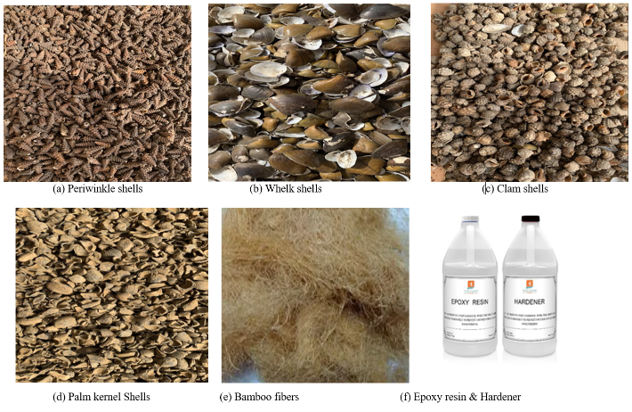
The choice of engineering materials substantially contributes to the longevity and output–to–input ratio of machines and structures. There is growing interest in sourcing local engineering materials that are more durable than synthetic materials. The mechanical characteristics of these engineering materials must meet acceptable standards. This study examined reinforcing hybrid agro-aquatic waste with epoxy resin as an additive. Since natural materials are biodegradable and renewable, they are an environmentally friendly alternative to conventional materials in engineering applications. This has led to a growing trend in using bio-composites made from natural materials. This study aimed to optimize the strength of hybrid agro-aquatic samples made from bamboo fiber, whelks, clams, periwinkle shells, and palm kernels bonded with resin to improve engineering performance. The composites were made using a hand lay-up technique with varying percentages of shells and fiber (10-30%), mixed with different amounts of epoxy resin. Tensile, impact, flexural, and water absorption tests were performed on the cured samples after 24 hours. The Taguchi L25 (5x5) orthogonal array was used to optimize the experimental trials in Minitab 18, with five design parameters at five levels each. The results showed an average flexural strength of 114.87 MPa, while the unreinforced bio-composite had 72.33 MPa. Turning agricultural waste into engineering materials such as bamboo fiber, clams, palm kernel shells, whelk shells, and periwinkle shells can positively impact the building industry.
- Ngo, T. D. (2018). Natural fibers for sustainable bio-composites. In: Gunay E, editor. Natural and Artificial FiberReinforced Composites as Renewable Sources. Croatia: IntechOpen. DOI: 10.5772 /intechopen. 71012.
- Anton du Plessis, Nima Razavi, Matteo Benedetti, Simone Murchio, Martin Leary, Marcus Watson, Dhruv B. (2022) Properties and applications of additively manufactured metallic cellular materials: A review. Progress in Materials Vol. 125, April 2022, 100918
- Yao X, Raine TP, Liu M, Zakaria M, Kinloch IA, Bissett MA (2021) Effect of graphene nanoplatelets on the mechanical and gas barrier properties of woven carbon fiber/epoxy composites. J Mate Sci, 1. https://doi.org/10.1007/s10853-021-06467-z
- Achukwu, E. O., Barnabas, A. M., Mamman, A. Uzochukwu, M. I. (2020), Fabrication of Palm Kernel Shell Epoxy Composites and Study of Their Mechanical Properties. Nigerian Journal of Materials Science and Engineering 6 (1) 32
- Stephen. A. Takim: Performance Characteristics and Evaluation of Alternate Materials for Automobile Advance Leaf Springs. IOSR Journal of mechanical and civil engineering (IOSR-JMCE) e-ISSN: 2278-1684, p-ISSN: 2320-334X, Volume 11, Issue 4 Ver.IV (Jul-Aug.2014), PP 28-30 www.iosrjournals.org.
- Akeke, G.A and Osadebe, N.N (2016) Variability in the Chemical Properties of Rice Husk Ash. USEP: Journal of Research Information in Civil Engineering. Vol.13, No. 2 pp 864-875
- Oromiehie E, Gangadhara P, Compston P, Rajan G (2019). Automated fiber placement based composite structures: Review on the defects, impacts and inspections techniques. Composite Structures. 2019; 110987:224. DOI: 10.1016 /j.compstruct. 2019.110987
- Akindapo, J O, Agov, E. T., Garba D. K., Ogabi, R. O. (2017). Comparative Assessment of Mechanical Properties of Groundnut Shell and Rice Husk Reinforced Epoxy Composites. American Journal of Mechanical Engineering 5 (3), 76-86
- Stephen Akong Takim, Franklyn Tochukwu Okeoma , Princewill C (Nwadinobi (2023). Optimization of the Flexural Strength of Biocomposite Samples Reinforced With Resin For Engineering Applications. www.preprints.org, 27 July 2023 doi:10.20944/preprints202307.1865.v1
- Sanjay MR, Arpitha GR, Naik LL, Gopalakrishna K, Yogesha B. (2016). Applications of natural fibers and its composites: An overview. Natural Resources. 7:108-114. DOI:10.4236/nr.2016.730
- Mousavi SR, Faraj Nejad S, Jafari M, Paydayesh A (2021) Polypropylene/ethylene propylene diene monomer/cellulose nanocrystal ternary blend nanocomposites: effects of different parameters on mechanical, rheological, and thermal properties. Polym Compos 42:4187
- G.A Akeke (2023) Optimization of the Structural Properties of RHA-Concrete using Osadebe’s Mathematical Program. Scientific Research Publishing. Engineering, Vol. 15 pp 446-457.
- Estaji S, Paydayesh A, Mousavi SR, Khonakdar HA, Abiyati MM (2021) Polycarbonate/poly (methyl methacrylate)/silica aerogel blend composites for advanced transparent thermal insulations: mechanical, thermal, and optical studies. Polym Compos 42:5323
- Ghanbari A, Sadat Jalili N, Haddadi SA, Arjmand M, Nofar M (2020) Mechanical properties of extruded glass fiber reinforced thermoplastic polyolefin composites. Polym Compos 41:3748
- Akeke, G.A et.al (2022) Compressive strength optimization of rice husk ash concrete using Scheffe’s mathematical model. Epítôanyagépítôanyag Journal of Silicate Based and Composite Materials Vol. 74, No. 4 2022/4
- Shi J, Yao R, Kong Z, Ni F, Zheng J (2021) Strength analysis on hybrid welding interface of polymer and short carbon fiber reinforced composite. Journal of Mater Sci, 1. https://doi.org/10.1007/s10853-021-06207-3
- Takim S. A and Okeoma T.F (2022) Characterization of Glass Fiber Reinforced Epoxy Composites. GUU-Journal of Interdisciplinary research and innovations Vol.1 NO.1, Pg 113-123, ISSN: 2992 – 4847, Dec.2022. http://www.guupjournal.net
- Safi, B., Saidi, M. Daoui, A. Bellal, A. Mechekak, A., Toumi, K (2015). The use of seashells as a fine aggregate (by sand substition) in selfcompacting mortar (SCM)”, Construction Building Materials 78(2015): 430-438
- Godwin Akeke; Shalom Eyo and Stephen Takim (2024): Improvement on Sustainable Construction Methods Using EPS and Rha as Bio Composite. International Journal of Civil Engineering and Technology (IJCIET), 15 (3), 2024, pp. 87-109. https://iaeme.com/Home/issue/IJCIET?Volum=15&Issue=3.
- Ikumapayi, O. M. and Akinlabi, E. T. (2018). Composition, Characteristics and Socioeconomic benefits of palm kernel shell exploitation – An overview” Journal of Environmental Science and Technology, 1(5), 220-232.
- Alias, N. S. Ismail, H. Wahab, M. K., Ragunathan, S. Ardhyananta, H. and Ting, S. S. (2018). Development of new material based on polyvinyl alcohol//palm kernel shell powder biocomposites,” Advances in Environmental Studies, vol. 2(2), pp. 98-107
- Razavi M, Sadeghi N, Jafari SH, Khonakdar HA, Wagenknecht U, Leuteritz A (2022) Thermo-rheological probe of microstructural evolution and degradation pathway in the flame-retarded PP/EVA/NOR/clay nanocomposites. Rheologica Acta 61:2.