A survey on intelligent transportation systems for accident detection and risk prediction using AI
The complexity of today's transportation networks has made road safety, accident detection, and risk management increasingly challenging. Intelligent Transportation Systems (ITS) offer a technological base to enhance transportation safety by incorporating sensors, communications, data processing, and intelligent decision-making. This review discusses the application of Artificial Intelligence (AI) for accident detection and risk prediction in ITS by examining information sources, methodologies, accident investigation, and associated challenges. It examines the use of machine learning, deep learning, computer vision, spatiotemporal modeling, and multimodal AI for accident detection, risk prediction, severity analysis, and active safety management. This review of studies suggests that collecting traffic, vehicle, road, environmental, geographical, historical, and driver-related information can improve understanding of collisions and support timely safety decisions. The review also highlights the importance of explainable and reliable AI that provides transparency, dependability, and accountability. However, the obstacles include data heterogeneity, model generalization, dynamic conditions, scalability, quick implementation, privacy considerations, security requirements, and compatible information systems. In conclusion, incorporating AI in ITS may have the power to shift road-safety management from reactive measures to data-driven approaches.
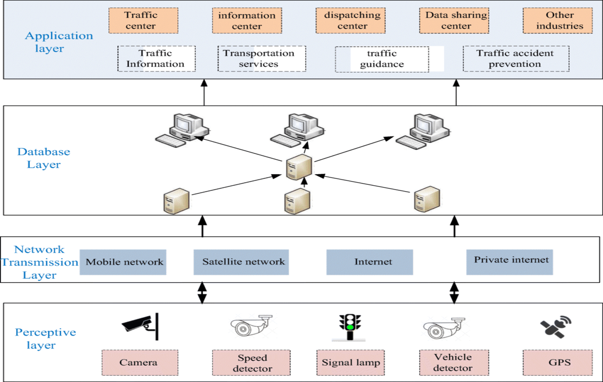
- T. Yuan, W. Da Rocha Neto, C. E. Rothenberg, K. Obraczka, C. Barakat, and T. Turletti, “Machine learning for next‐generation intelligent transportation systems: A survey,” Trans. Emerg. Telecommun. Technol., vol. 33, no. 4, pp. 1–35, November, Apr. 2022, doi: 10.1002/ett.4427.
- M. Elassy, M. Al-Hattab, M. Takruri, and S. Badawi, “Intelligent transportation systems for sustainable smart cities,” Transp. Eng., vol. 16, p. 100252, Jun. 2024, doi: 10.1016/j.treng.2024.100252.
- K. M. Hussain and S. C. Pallaprolu, “Improving Passenger Safety with Machine Learning Techniques on 2022 Incident Data,” in 2025 International Conference on Sensors and Related Networks (SENNET) Special Focus on Digital Healthcare (64220), Vellore, India: IEEE, 2025, pp. 1–6, July. doi: 10.1109/SENNET64220.2025.11136102.
- S. Aluko, “Security Challenges and Risk Analysis in Intelligent Transportation Systems,” Feb. 27, 2026. doi: 10.36227/techrxiv.177223070.03782885/v1.
- Y. Pei, Y. Wen, and S. Pan, “Road Traffic Accident Risk Prediction and Key Factor Identification Framework Based on Explainable Deep Learning,” in IEEE Access, 2024, pp. 120597–120611. doi: 10.1109/ACCESS.2024.3451522.
- D. G. Takale, S. D. Gunjal, V. N. Khan, A. Raj, and S. N. Gujar, “Road Accident Prediction Model Using Data Mining Techniques,” NeuroQuantology, vol. 20, no. 16, pp. 2904–2101, November, 2022, doi: 10.48047/NQ.2022.20.16.NQ880299.
- H. K. Yadav, “Design and Implement Machine Learning Based Predictive Analytics for Road Safety and Accident Prevention,” in 2026 IEEE International Conference on Interdisciplinary Approaches in Technology and Management for Social Innovation (IATMSI), Gwalior, India: IEEE, 2026, pp. 1–6, March. doi: 10.1109/IATMSI68868.2026.11465965.
- J. P. Bharadiya, “Artificial Intelligence in Transportation Systems A Critical Review,” Am. J. Comput. Eng., vol. 6, no. 1, pp. 34–45, Jun. 2023, doi: 10.47672/ajce.1487.
- D. Gangwani and P. Gangwani, “Applications of Machine Learning and Artificial Intelligence in Intelligent Transportation System: A Review,” in Applications of Artificial Intelligence and Machine Learning, A. Choudhary, A. P. Agrawal, R. Logeswaran, and B. Unhelkar, Eds., Singapore: Springer Singapore, 2021, pp. 203–216.
- A. M. Mostafa et al., “AI-based prediction of traffic crash severity for improving road safety and transportation efficiency,” Sci. Rep., vol. 15, no. 1, p. 27468, 2025, doi: 10.1038/s41598-025-10970-7.
- R. Abduljabbar, H. Dia, S. Liyanage, and S. A. Bagloee, “Applications of Artificial Intelligence in Transport: An Overview,” Sustainability, vol. 11, no. 1, p. 189, Jan. 2019, doi: 10.3390/su11010189.
- N. Niture and I. Abdellatif, “A systematic review of factors, data sources, and prediction techniques for earlier prediction of traffic collision using AI and machine Learning,” in Multimedia Tools and Applications, 2025, pp. 19009–19037. doi: 10.1007/s11042-024-19599-6.
- J. Casademont, A. Calveras, D. Quiñones, M. Navarro, J. Arribas, and M. Catalan-Cid, “Cooperative-Intelligent Transport Systems for Vulnerable Road Users Safety,” in 2019 7th International Conference on Future Internet of Things and Cloud (FiCloud), IEEE, Aug. 2019, pp. 141–146. doi: 10.1109/FiCloud.2019.00027.
- G. Santo, L. Santos, R. L. C. Costa, and C. Rabadão, “Intelligent Transportation Systems Security and Privacy,” in Information Security and Privacy in Smart Devices: Tools, Methods, and Applications, 2023, pp. 122–141. doi: 10.4018/978-1-6684-5991-1.ch005.
- S. Sreevathsa, “Strategies for Reducing Alert Fatigue and Improving Signal Quality in Enterprise Monitoring Architectures,” Int. J. Adv. Eng. Manag. Sci., vol. 12, no. 3, pp. 444–451, 2026, doi: 10.22161/ijaems.123.42.
- M. F. I. Buian, R. A. Arde, M. M. Billah, A. Debnath, I. Md, and Siddique, “Advanced analytics for predicting traffic collision severity assessment,” World J. Adv. Res. Rev., vol. 21, no. 2, pp. 2007–2018, Feb. 2024, doi: 10.30574/wjarr.2024.21.2.0704.
- X. Shi, Y. D. Wong, M. Z. F. Li, and C. Chai, “Key risk indicators for accident assessment conditioned on pre-crash vehicle trajectory,” Accid. Anal. Prev., vol. 117, pp. 346–356, Aug. 2018, doi: 10.1016/j.aap.2018.05.007.
- B. Tyagi, A. Agrawal, H. Jajaniya, and G. Bhardwaj, “Smart Traffic Management and Accident Detection System: A Review,” DMPedia Lect. Notes Comput. Sci. Eng., vol. 1, no. Impact, pp. 335–345, Mar. 2026, doi: 10.65890/dmp-lncse.IMPACT26.138.
- S. Jaydarifard, T. Yigitcanlar, and A. Paz, “Risk factors and safety strategies for mitigating violations, harassment and assault in taxi and ride-hailing services,” Transp. Rev., vol. 45, no. 5, pp. 776–800, Sep. 2025, doi: 10.1080/01441647.2025.2512251.
- E. Naranjo, J. D. Erazo Rodríguez, I. Sinaluisa, and N. Ulloa, “Artificial Intelligence and Computer Vision for Intelligent Traffic Light Systems: A Systematic Review,” Automation, vol. 7, no. 4, 2026, doi: 10.3390/automation7040113.
- S. Darla, K. P, U. K. A, P. B. R, and V. D, “Automated Vehicle Collision Detection: Multi-Model Computer Vision Framework,” in 2026 International Conference on Intelligent and Innovative Technologies in Computing, Electrical and Electronics (IITCEE), IEEE, Jan. 2026, pp. 1–9. doi: 10.1109/IITCEE67948.2026.11394603.
- S. Guo et al., “Sparse Traffic Accident Risk Forecasting With Spatial-Temporal Knowledge Graphs,” IEEE Trans. Knowl. Data Eng., vol. 38, no. 9, pp. 6152–6165, 2026, doi: 10.1109/TKDE.2026.3706345.
- F. Adeola and E. Dave, “Hybrid Deep Learning Architecture For Predicting Neurological Disorders And Road Accident Severity,” Apr. 10, 2026. doi: 10.22541/au.177585097.72176336/v1.
- N. Barua and M. Hitosugi, “A Multi-Modal AI System for Detecting Pedestrians Lying on the Road: Simulation-Based Safety and Injury Risk Analysis,” Vehicles, vol. 8, no. 6, p. 136, 2026, doi: 10.3390/vehicles8060136.
- O. I. Aboulola, E. A. Alabdulqader, A. A. AlArfaj, S. Alsubai, and T.-H. Kim, “An Automated Approach for Predicting Road Traffic Accident Severity Using Transformer Learning and Explainable AI Technique,” IEEE Access, vol. 12, pp. 61062–61072, 2024, doi: 10.1109/ACCESS.2024.3380895.
- D. Santos, J. Saias, P. Quaresma, and V. B. Nogueira, “Machine Learning Approaches to Traffic Accident Analysis and Hotspot Prediction,” Computers, vol. 10, no. 12, 2021, doi: 10.3390/computers10120157.
- Z. Jin and B. Noh, “From Prediction to Prevention: Leveraging Deep Learning in Traffic Accident Prediction Systems,” Electronics, vol. 12, no. 20, 2023, doi: 10.3390/electronics12204335.
- S. Moosavi, M. H. Samavatian, S. Parthasarathy, R. Teodorescu, and R. Ramnath, “Accident Risk Prediction based on Heterogeneous Sparse Data: New Dataset and Insights,” in Proceedings of the 27th ACM SIGSPATIAL International Conference on Advances in Geographic Information Systems, in SIGSPATIAL ’19. New York, NY, USA: Association for Computing Machinery, 2019, pp. 33–42. doi: 10.1145/3347146.3359078.
- N. Fiorentini, D. Pellegrini, and M. Losa, “Overfitting Prevention in Accident Prediction Models: Bayesian Regularization of Artificial Neural Networks,” Transp. Res. Rec. J. Transp. Res. Board, vol. 2677, no. 2, pp. 1455–1470, Feb. 2023, doi: 10.1177/03611981221111367.
- S. Adomako, I. K. V. Amponsah, D. K. Mensah, and J. Damsere-Derry, “Road Accident Case Modeling in Ghana: A Perspective of Negative Binomial–Based Generalized Linear Models,” J. Probab. Stat., vol. 2025, no. 1, p. 10, Jan. 2025, doi: 10.1155/jpas/3900755.
- M. Graf, D. Steinhauser, O. Vaculín, and T. Brandmeier, “Impact of Adverse Weather on Road Safety: A Survey of Test Methods for Enhancing Safety of Automated Vehicles and Sensor Robustness in Challenging Environmental Conditions,” in IEEE Access, 2025, pp. 179817–179838. doi: 10.1109/ACCESS.2025.3622501.
- A. Pembuain, S. Priyanto, and L. Suparma, “The Effect of Road Infrastructure on Traffic Accidents,” in Proceedings of the 11th Asia Pacific Transportation and the Environment Conference (APTE 2018), Paris, France: Atlantis Press, 2019. doi: 10.2991/apte-18.2019.27.
- F. Alanazi and M. Alenezi, “Interoperability for intelligent traffic management systems in smart cities,” Int. J. Electr. Comput. Eng., vol. 14, no. 2, pp. 1864–1874, April, 2024, doi: 10.11591/ijece.v14i2.pp1864-1874.
- A. Srivastava, R. Kalim, K. K. Singh, S. Srivastava, A. Choudhary, and V. S. Sharma, “Intelligent Road Accident Risk Prediction Using Multi-Modal Spatio-Temporal Data and Machine Learning,” in 2026 6th International Conference on Emerging VLSI and Semiconductor Technology for AI and Computing Applications (EVST), Ghaziabad, India: IEEE, 2026, pp. 1–6, June. doi: 10.1109/EVST69093.2026.11660585.
- A. Subbiah, N. ’Ain Amirrudin, N. I. A. Katim, R. Hamidun, T. P. Subramaniam, and A. Mahfoud, “Mitigating Microsleep-Related Accidents in Commercial Transport: An IoT-Based Detection and Instant Alert System for Enhancing Driver Safety and Road Security,” in 2025 IEEE International Conference on Automatic Control and Intelligent Systems (I2CACIS), Kuala Lumpur, Malaysia: IEEE, 2025, pp. 7–12, June. doi: 10.1109/I2CACIS65476.2025.11101236.
- A. P, S. B, V. K. I, and A. K, “AI-Powered Real-Time Accident Detection Through Integration of Driver Health and Vehicle Dynamics,” in 2025 2nd International Conference on Trends in Engineering Systems and Technologies (ICTEST), Ernakulam, India: IEEE, 2025, pp. 1–6, April. doi: 10.1109/ICTEST64710.2025.11042307.
- B. S, J. A. D, P. N. Renjith, and K. Ramesh, “DDSS: Driver decision support system based on the driver behaviour prediction to avoid accidents in intelligent transport system,” Int. J. Cogn. Comput. Eng., vol. 5, pp. 1–13, 2024, doi: 10.1016/j.ijcce.2023.12.001.
- V. Adewopo, N. Elsayed, Z. ElSayed, M. Ozer, V. Wangia-Anderson, and A. Abdelgawad, “AI on the Road: A Comprehensive Analysis of Traffic Accidents and Autonomous Accident Detection System in Smart Cities,” in 2023 IEEE 35th International Conference on Tools with Artificial Intelligence (ICTAI), IEEE, Nov. 2023, pp. 501–506. doi: 10.1109/ICTAI59109.2023.00080.
- S. Olugbade, S. Ojo, A. L. Imoize, J. Isabona, and M. O. Alaba, “A Review of Artificial Intelligence and Machine Learning for Incident Detectors in Road Transport Systems,” Math. Comput. Appl., vol. 27, no. 5, p. 77,September, 2022, doi: 10.3390/mca27050077.