Air quality index forecasting under seasonal and long-term environmental dynamics
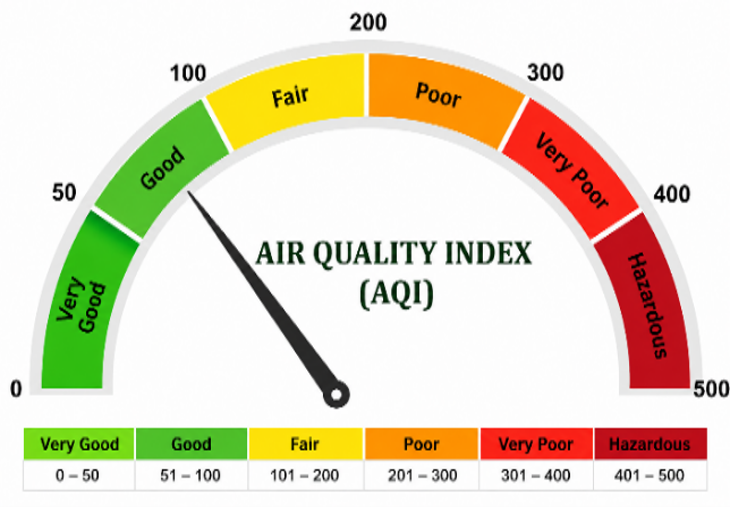
The Air Quality Index (AQI) indicates air pollution levels and their associated risks to human health and the environment. Factors influencing AQI include temperature, humidity, wind, precipitation, air pressure, seasonal variations, changes in industrial and urbanization patterns, and major pollutants such as PM2.5, PM10, NO2, SO2, CO, and O3. This paper discusses AQI geography and timing, as well as the relationship between air pollution and climate systems. It gives special attention to seasonal fluctuations and regional differences in pollution, dispersion, radiative forcing, short-lived climate pollutants, deforestation, and urbanization. The study also addresses seasonal and long-term environmental variations that affect pollutant levels and AQI. The study recognizes the importance of AQI forecasting for pollution assessment, public information, health protection, resource allocation, enforcement, location ranking, trend analysis, and timely assessment. The assessment also highlights key challenges, including potential variation in pollutant locations, monitoring difficulties, data reliability, the lack of direct studies on air quality indexes, and limited validation for real-time applications. To develop efficient air-quality management plans and provide precise, trustworthy air-quality forecasts, it is crucial to understand these environmental and temporal factors.
- A. Joon, “Smart Predictive Maintenance: AI-Driven Adaptation for Industrial Equipment,” in 2025 IEEE North-East India International Energy Conversion Conference and Exhibition (NE-IECCE), IEEE, Jul. 2025, pp. 1–6. doi: 10.1109/NE-IECCE64154.2025.11183108.
- Kanchan, A. K. Gorai, and P. Goyal, “A review on air quality indexing system,” Asian J. Atmos. Environ., vol. 9, no. 2, pp. 101–113, 2015, doi: 10.5572/ajae.2015.9.2.101.
- K. Dimitriou, A. K. Paschalidou, and P. A. Kassomenos, “Assessing air quality with regards to its effect on human health in the European Union through air quality indices,” Ecol. Indic., vol. 27, pp. 108–115, 2013, doi: 10.1016/j.ecolind.2012.11.023.
- C. Andenna and R. V. Gagliardi, “Insights into Air Quality Index (AQI) Variability with Explainable Machine Learning Techniques,” in The 7th International Electronic Conference on Atmospheric Sciences (ECAS-7), Basel Switzerland: MDPI, Aug. 2025, p. 1. doi: 10.3390/eesp2025034001.
- A. Bekkar, B. Hssina, S. Douzi, and K. Douzi, “Air-pollution prediction in smart city, deep learning approach,” J. Big Data, vol. 8, no. 1, p. 161, 2021, doi: 10.1186/s40537-021-00548-1.
- A. Yenkikar, V. P. Mishra, M. Bali, and T. Ara, “Explainable forecasting of air quality index using a hybrid random forest and ARIMA model,” MethodsX, vol. 15, p. 103517, Dec. 2025, doi: 10.1016/j.mex.2025.103517.
- K. Chatterjee et al., “HoST: integrating Heuristic knowledge with attention-based LSTM networks for Thunderstorm prediction,” Sci. Rep., Jul. 2026, doi: 10.1038/s41598-026-57889-1.
- C. Ravaglioli, L. Benedetti-Cecchi, I. Bertocci, E. Maggi, M. Uyà, and F. Bulleri, “The role of environmental conditions in regulating long-term dynamics of an invasive seaweed,” Biol. Invasions, vol. 24, no. 4, pp. 1175–1187, Apr. 2022, doi: 10.1007/s10530-021-02680-8.
- A. Tiwari, A. Kumar, M. Pradesh, and M. Pradesh, “Air Quality Index Prediction : A Review of Machine Learning , Deep Learning , and Hybrid Approaches,” vol. 060253, pp. 1–10, 2026, doi: 10.5281/zenodo.20626963.
- IQAir. (n.d.)., “India Air Quality Index (AQI) and Air Pollution information,” 2023. https://www.iqair.com/air-quality/india
- X. Wang, X. He, S. Miao, and Y. Dou, “Numerical simulation of the influence of aerosol radiation effect on urban boundary layer,” Sci. China Earth Sci., vol. 61, no. 12, pp. 1844–1858, 2018, doi: 10.1007/s11430-018-9260-0.
- S. Alsowaidan, A. Al-Hurban, A. Alsaber, and A. Anbar, “Assessment of seasonal variations in the air quality index (2019–2022) in Al-Jahra city, Kuwait,” Kuwait J. Sci., vol. 51, no. 4, p. 100280, 2024, doi: 10.1016/j.kjs.2024.100280.
- S. Mohapatra, J. G. Singh, and M. Mishra, “Inter-linkage between air pollution, climate change, and human health: A comprehensive review and AI-driven insights,” Clim. Phys. Atmos. Sci. Sci. Insights Soc. Challenges, vol. 3–4, p. 100021, 2026, doi: 10.1016/j.cpas.2026.100021.
- V. Ramanathan and Y. Feng, “Air pollution, greenhouse gases and climate change: Global and regional perspectives,” Atmos. Environ., vol. 43, no. 1, pp. 37–50, 2009, doi: 10.1016/j.atmosenv.2008.09.063.
- D. Shindell et al., “Simultaneously Mitigating Near-Term Climate Change and Improving Human Health and Food Security,” Science (80-. )., vol. 335, no. 6065, pp. 183–189, 2012, doi: 10.1126/science.1210026.
- T. C. Bond et al., “Bounding the role of black carbon in the climate system: A scientific assessment,” J. Geophys. Res. Atmos., vol. 118, no. 11, pp. 5380–5552, 2013, doi: 10.1002/jgrd.50171.
- P. S. Monks et al., “Tropospheric ozone and its precursors from the urban to the global scale from air quality to short-lived climate forcer,” Atmos. Chem. Phys., vol. 15, no. 15, pp. 8889–8973, 2015, doi: 10.5194/acp-15-8889-2015.
- R. A. Houghton and A. A. Nassikas, “Global and regional fluxes of carbon from land use and land cover change 1850–2015,” Global Biogeochem. Cycles, vol. 31, no. 3, pp. 456–472, 2017, doi: 10.1002/2016GB005546.
- A. Karimi, P. Mohammad, A. García-Martínez, D. Moreno-Rangel, D. Gachkar, and S. Gachkar, “New developments and future challenges in reducing and controlling heat island effect in urban areas,” Environ. Dev. Sustain., vol. 25, no. 10, pp. 10485–10531, 2023, doi: 10.1007/s10668-022-02530-0.
- X. Guo et al., “Air quality improvement and health benefit of PM2.5 reduction from the coal cap policy in the Beijing–Tianjin–Hebei (BTH) region, China,” Environ. Sci. Pollut. Res., vol. 25, no. 32, pp. 32709–32720, 2018, doi: 10.1007/s11356-018-3014-y.
- M. Bose and K. Mali, “Designing fuzzy time series forecasting models: A survey,” Int. J. Approx. Reason., vol. 111, pp. 78–99, 2019, doi: 10.1016/j.ijar.2019.05.002.
- S. Di Sabatino, R. Buccolieri, and P. Salizzoni, “Recent advancements in numerical modelling of flow and dispersion in urban areas: a short review,” Int. J. Environ. Pollut., vol. 52, no. 3/4, p. 172, 2013, doi: 10.1504/IJEP.2013.058454.
- S. Shelton et al., “Seasonal Variability of Air Pollutants and Their Relationships to Meteorological Parameters in an Urban Environment,” Adv. Meteorol., vol. 2022, no. 1, p. 5628911, 2022, doi: 10.1155/2022/5628911.
- S. Park et al., “Studying Air Pollutants Origin and Associated Meteorological Parameters over Seoul from 2000 to 2009,” Adv. Meteorol., vol. 2015, 2015, doi: 10.1155/2015/704178.
- A.-A. M. Basil, C. C. Okwuosa, F. O. Uzuegbuanam, and L. E. Ugwu, “A seasonal investigation of indoor air quality in relation to architectural features in government office buildings in Enugu, Nigeria,” Sci. Rep., vol. 14, no. 1, p. 26885, Nov. 2024, doi: 10.1038/s41598-024-78160-5.
- S. L. Allcock, “Long-term socio-environmental dynamics and adaptive cycles in Cappadocia, Turkey during the Holocene,” Quat. Int., vol. 446, pp. 66–82, Aug. 2017, doi: 10.1016/j.quaint.2017.06.065.
- M. Karmoude et al., “Machine learning for air quality prediction and data analysis: Review on recent advancements, challenges, and outlooks,” Sci. Total Environ., vol. 1002, p. 180593, 2025, doi: 10.1016/j.scitotenv.2025.180593.
- A. Pant, S. Sharma, and K. Pant, “Evaluation of Machine Learning Algorithms for Air Quality Index (AQI) Prediction,” J. Reliab. Stat. Stud., Dec. 2023, doi: 10.13052/jrss0974-8024.1621.
- K. Rajesh and S. R. Kumar, “Deep Reinforcement Learning for Urban Air Quality Management: Multi-Objective Optimization of Pollution Mitigation Booth Placement in Metropolitan Environments,” IEEE Access, vol. 13, pp. 146503–146526, 2025, doi: 10.1109/ACCESS.2025.3599541.
- J. Bernacki and R. Scherer, “A Comprehensive Review of Data-Driven Techniques for Air Pollution Concentration Forecasting.,” Sensors (Basel)., vol. 25, no. 19, Oct. 2025, doi: 10.3390/s25196044.
- G. S. Manivannan, R. Mariyam, and F. Zahara, “An Efficient Ensemble and Boosting Based Regression Framework for Air Quality Index Forecasting in Hassan District of Karnataka,” in 2026 International Conference on Recent Advancement in Electrical, Computer and Communication Technologies (IECCT), 2026, pp. 1–5. doi: 10.1109/IECCT68664.2026.11541582.
- L. Troll, Y. C. Law, and D. Zielasko, “ChronoShore: Diegetic Exploration of Short- and Long-Term Environmental Time in a Virtual Coastal Ecosystem,” in 2026 IEEE Conference on Virtual Reality and 3D User Interfaces Abstracts and Workshops (VRW), 2026, pp. 1423–1424. doi: 10.1109/VRW70859.2026.00386.
- P. Gudimilla, A. Banu, S. Hasanoddin, B. Maheshwari, and R. Vishal, “Enhanced Air Quality Index Prediction using SARIMA Model TLSTM Network and Hybrid Modeling,” in 2025 2nd International Conference on Recent Trends in Electrical, Electronics and Computing Technologies (ICRTEECT), 2025, pp. 1–6. doi: 10.1109/ICRTEECT67512.2025.11448937.
- K. V. Reddy, C. M. Begum, A. Neeraja, and J. C., “Enhancing Air Quality Index Forecasting through Machine Learning Models,” in 2025 3rd International Conference on Intelligent Systems, Advanced Computing and Communication (ISACC), 2025, pp. 1188–1194. doi: 10.1109/ISACC65211.2025.10969305.
- V. Shah, K. Patel, R. K. Gupta, and H. Yagnik, “Advancements in Air Quality Forecasting using Artificial Intelligence: A Comprehensive Analysis,” in 2024 Asia Pacific Conference on Innovation in Technology (APCIT), 2024, pp. 1–6. doi: 10.1109/APCIT62007.2024.10673466.
- S. Swamynathan, N. Sneha, S. P. Ramesh, R. Niranjana, D. D. N. Ponkumar, and R. Saravanakumar, “A Machine Learning Approach for Predicting Air Quality Index in Smart Cities,” in 2024 International Conference on IoT Based Control Networks and Intelligent Systems (ICICNIS), 2024, pp. 1609–1615. doi: 10.1109/ICICNIS64247.2024.10823106.
- S. R. Sakib et al., “Time Series Analysis and Forecasting of Air Quality Index of Dhaka City of Bangladesh,” in 2023 IEEE World AI IoT Congress (AIIoT), IEEE, Jun. 2023, pp. 0063–0069. doi: 10.1109/AIIoT58121.2023.10174539.