Review Process
Future Engineering Research (FER) is committed to maintaining the highest standards of scientific quality, editorial integrity, transparency, and publication ethics. Every manuscript submitted to the journal undergoes a rigorous editorial and peer-review process designed to ensure that published articles make significant, original, and scientifically sound contributions to engineering research and practice. The journal follows internationally recognized principles of scholarly publishing and adheres to the ethical recommendations of the Committee on Publication Ethics (COPE).
All manuscripts must be submitted through the journal's online submission system and accompanied by a cover letter confirming that the work is original, has not been published previously, is not under consideration elsewhere, and complies with the journal's ethical and authorship policies. Where applicable, authors are also required to provide declarations regarding conflicts of interest, funding sources, ethical approvals, data availability, and copyright.
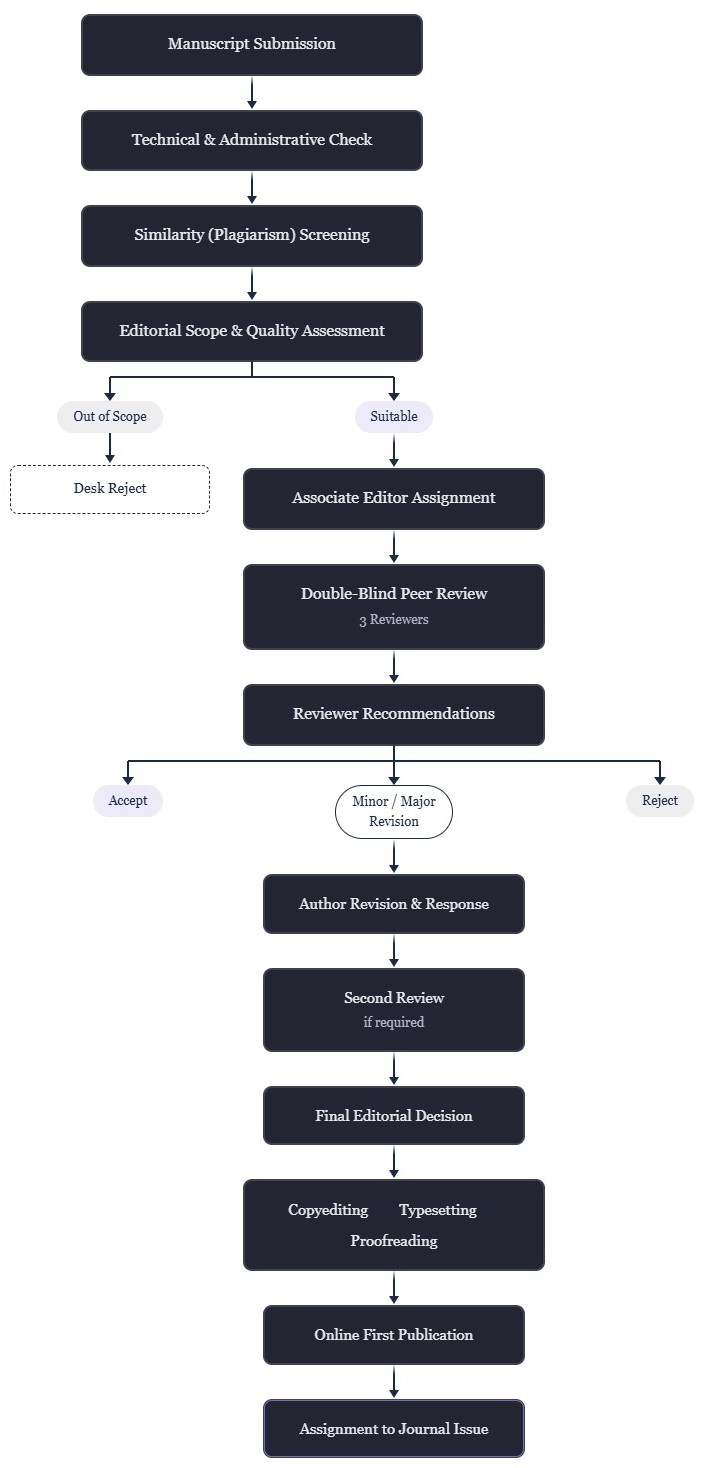
Upon submission, each manuscript undergoes an initial editorial screening conducted by the Editor-in-Chief or a designated Associate Editor. During this stage, the manuscript is evaluated for its relevance to the journal's scope, scientific significance, originality, methodological quality, presentation, and compliance with the journal's submission requirements. Similarity screening is performed using plagiarism-detection software to identify plagiarism, duplicate publication, excessive text recycling, image manipulation, or other forms of publication misconduct. Manuscripts that do not satisfy the journal's editorial standards or ethical requirements may be rejected without external peer review, allowing authors to seek publication elsewhere without unnecessary delay.
Manuscripts that successfully pass the preliminary assessment proceed to a double-blind peer-review process, in which the identities of both authors and reviewers remain anonymous throughout the review. Each manuscript is normally evaluated by at least three independent expert reviewers with recognized expertise in the relevant field. Reviewers are selected based on their scientific qualifications, publication record, and absence of conflicts of interest. Whenever possible, reviewers are recruited from institutions different from those of the authors and from diverse geographical regions to ensure fairness, objectivity, and an international perspective.
Reviewers evaluate manuscripts according to clearly defined criteria, including scientific originality, technical quality, methodological rigor, experimental or computational validation, significance of the findings, clarity of presentation, adequacy of references, reproducibility of the research, ethical compliance, and contribution to the advancement of engineering knowledge. Reviewers provide detailed comments intended to assist both the editors and the authors in improving the quality, clarity, and impact of the manuscript.
Based on the reviewers' recommendations, the handling editor may recommend one of the following editorial decisions:
- Accept without revision;
- Minor revision;
- Major revision;
- Reject with the opportunity for resubmission as a substantially revised manuscript; or
- Reject.
When revisions are requested, authors are expected to submit a revised manuscript together with a detailed point-by-point response explaining how each reviewer comment has been addressed. Revised manuscripts may be returned to the original reviewers for further evaluation when necessary. The final publication decision is made solely by the Editor-in-Chief or the assigned handling editor after careful consideration of all reviewer reports, the authors' responses, and the overall scientific merit of the work. Editorial decisions are made independently and are not determined solely by reviewer recommendations.
FER is committed to providing an efficient and transparent review process while maintaining rigorous scientific standards. Under normal circumstances, authors receive the first editorial decision within 4–6 weeks after submission, although review times may vary depending on reviewer availability and the complexity of the manuscript. Accepted articles are published online promptly after completion of copyediting, proofreading, typesetting, and final author approval.
The journal continuously monitors the performance of its editorial and peer-review process to ensure fairness, consistency, and efficiency. Review statistics, editorial performance indicators, and publication timelines are periodically assessed to support continuous improvement and to maintain international publishing standards.