Oil, labor, and the fraying social contract: a review of energy justice and future energy transition in Trinidad and Tobago
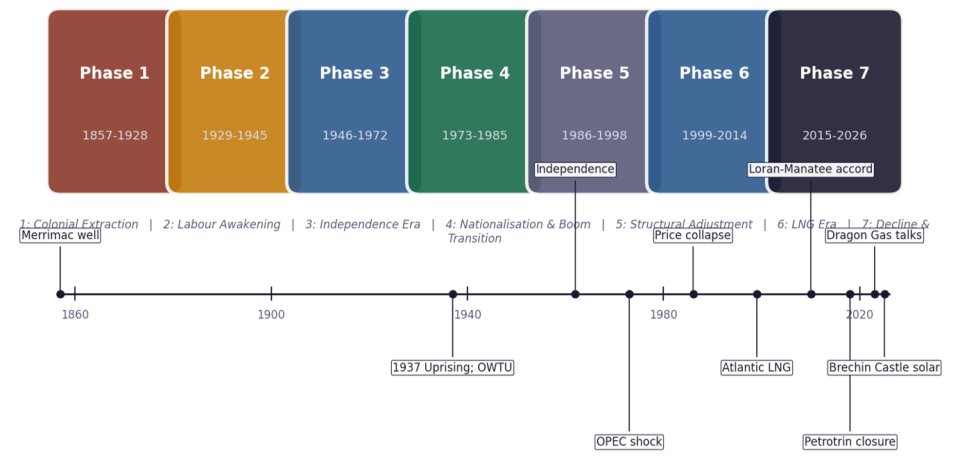
This review explores the history of Trinidad and Tobago's hydrocarbon sector through the lens of energy justice. The unresolved issue in Trinidad and Tobago, as in many petro states, is achieving a democratic transition that genuinely includes affected people. Energy justice is the starting point for sustainable transition. It considers future energy systems, decarbonization, and sustainable policies. Drawing on peer-reviewed literature, government archives, and comparative studies with other nations, the review covers 169 years of oil and gas, from the first drilled Merrimac well in 1857 to current plans for cross-border gas cooperation with Venezuela and a 30% renewable-energy electricity target by 2030. Adopting a three-level energy justice approach of distributional, procedural, and recognition justice, the paper analyses four events: the 1937 labor unrest, OWTU campaigns (1960-1985), the Alutrint case, and the Petrotrin refinery closure in 2018. The study finds a degradation of the extractive social contract: a weaker state-citizen relationship driven by rent-based governance rather than democratic accountability. Unlike Norway, Nigeria, Venezuela, Alaska, and Scotland, Trinidad and Tobago is characterized by procedural and recognition justice problems of distressed petro-states rather than transition countries. This paper proposes a new social contract model that emphasizes participatory energy governance, transparent benefit distribution, planning for a just transition and energy democracy, and a path to decarbonization through 2065. In accordance with PRISMA 2020, the paper employs the Scopus, Web of Science, JSTOR, Google Scholar, and UWI Library Repository databases, analyzing 61 documents out of 1256. The key innovation lies in combining historical political economy with future-oriented policy, connecting energy justice diagnostics to practical institutional reforms, and overcoming political economy obstacles that have prevented reforms in Trinidad and Tobago.
- Ministry of Energy and Energy Industries. (2024). Historical facts on the petroleum industry of Trinidad and Tobago. Government of Trinidad and Tobago. https://www.energy.gov.tt/historical-facts-petroleum/
- American Oil & Gas Historical Society. (2023). Colonel Edwin Drake and the first oil well. https://aoghs.org/
- Lund, H., & Mathiesen, B. V. (2009). Energy system analysis of 100% renewable energy systems: The case of Denmark in years 2030 and 2050. Energy, 34(5), 524–531. https://doi.org/10.1016/j.energy.2008.04.003
- United Nations Office of the High Representative for Least Developed Countries, Landlocked Developing Countries and Small Island Developing States. (2024). About Small Island Developing States. https://www.un.org/ohrlls/content/about-small-island-developing-states
- Ackah-Baidoo, A. (2012). Enclave development and ‘offshore’ corporate social responsibility: Implications for oil-rich sub-Saharan Africa. Resources Policy, 37(2), 152–159. https://doi.org/10.1016/j.resourpol.2011.12.010
- Liu, X., Peerally, J. A., De Fuentes, C., Ince, D., & Vredenburg, H. (2022). Who makes or breaks energy policymaking in the Caribbean small island jurisdictions? A study of stakeholders’ perceptions. Sustainability, 14(3), 1902. https://doi.org/10.3390/su14031902
- Jobson, R. C. (2024). The petro-state masquerade: Oil, sovereignty, and power in Trinidad and Tobago. University of Chicago Press.
- Ministry of Finance, Government of Trinidad and Tobago. (2019). Review of the economy 2019. https://www.finance.gov.tt/wp-content/uploads/2019/10/REVIEW-OF-THE-ECONOMY-2019-1.pdf
- Global Energy Monitor. (2026). Dragon gas pipeline. https://www.gem.wiki/Dragon_Gas_Pipeline
- Palacios, L., Rivera Rivota, D., & Joseph, I. (2026). More efficient use of Venezuela’s natural gas could strengthen the region’s energy security and the country’s electricity sector. Center on Global Energy Policy, Columbia University. https://www.energypolicy.columbia.edu/more-efficient-use-of-venezuelas-natural-gas/
- Jenkins, K., McCauley, D., Heffron, R., Stephan, H., & Rehner, R. (2016). Energy justice: A conceptual review. Energy Research & Social Science, 11, 174–182. https://doi.org/10.1016/j.erss.2015.10.004
- Heffron, R. J., & McCauley, D. (2017). The concept of energy justice across the disciplines. Energy Policy, 105, 658–667. https://doi.org/10.1016/j.enpol.2017.03.018
- Government of Trinidad and Tobago. (2025). Trinidad and Tobago Second Nationally Determined Contribution (NDC) 2025–2035. UNFCCC. https://unfccc.int/sites/default/files/2026-01/Trinidad%20and%20Tobago%20Second%20NDC%20%20.pdf
- BP Trinidad and Tobago. (2025). Brechin Castle Solar Limited achieves first electrons. https://www.bp.com/en_tt/trinidad-and-tobago/home/news/press-releases/solar-first-electrons.html
- Caribbean Centre for Renewable Energy and Energy Efficiency. (2023). 2023 Trinidad and Tobago energy report card. https://cekh.ccreee.org/wp-content/uploads/2025/07/2023-Trinidad-and-Tobago-Energy-Report-Card-1.pdf
- Randy Ramadhar Singh, Ricardo M. Clarke, Xsitaaz T. Chadee, Transitioning from 100 percent natural gas power to include renewable energy in a hydrocarbon economy, Smart Energy, Volume 5,2022,100060,ISSN 2666-9552, https://doi.org/10.1016/j.segy.2021.100060.
- Chadee, X. T., & Clarke, R. M. (2018). Wind resources and the levelized cost of wind generated electricity in the Caribbean islands of Trinidad and Tobago. Renewable and Sustainable Energy Reviews, 81, 2526–2540. https://doi.org/10.1016/j.rser.2017.06.059
- Bouzarovski, S., & Petrova, S. (2015). A global perspective on domestic energy deprivation: Overcoming the energy poverty–fuel poverty binary. Energy Research & Social Science, 10, 31–40. https://doi.org/10.1016/j.erss.2015.06.007
- Page, M. J., McKenzie, J. E., Bossuyt, P. M., et al. (2021). The PRISMA 2020 statement: An updated guideline for reporting systematic reviews. BMJ, 372, n71. https://doi.org/10.1136/bmj.n71
- International Monetary Fund. (2023). Trinidad and Tobago: 2023 Article IV consultation—Press release; staff report; and statement by the Executive Director for Trinidad and Tobago (Country Report No. 23/157). https://www.elibrary.imf.org/view/journals/002/2023/157/article-A001-en.xml
- Vincent, G. (2016). The Oilfields Workers’ Trade Union and the challenge of working class political party formation and electoral politics, 1965–1977. WorkingUSA, 19(4), 487–502. https://doi.org/10.1111/wusa.12266
- Ramadhar Singh, R., Clarke, R. M., & Chadee, X. T. (2024). Prosperity post fossil fuels: Policy briefing for a just energy transition in Trinidad and Tobago. Climate Strategies. [Note: Represents the author’s own stakeholder consultation process; treated as primary data, not as independent secondary literature.] https://climatestrategies.org/publication/prosperity-post-fossil-fuels-briefing-trinidad-and-tobago/
- Karl, T. L. (1997). The paradox of plenty: Oil booms and petro-states. University of California Press. ISBN: 9780520918696, 052091869X
- Brereton, B. (1981). A history of modern Trinidad, 1783–1962. Heinemann. ISBN: 9780435981167, 0435981161
- Bolland, O. N. (2001). The politics of labour in the British Caribbean. Ian Randle Publishers. ISBN: 9789768123954, 9768123958
- McCauley, D., Heffron, R. J., Stephan, H., & Jenkins, K. (2013). Advancing energy justice: The triumvirate of tenets. International Energy Law Review, 32(3), 107–110. https://research-repository.st-andrews.ac.uk/handle/10023/6078
- Sovacool, B. K., & Dworkin, M. H. (2015). Energy justice: Conceptual insights and practical applications. Applied Energy, 142, 435–444. https://doi.org/10.1016/j.apenergy.2015.01.002
- Sovacool, B. K., Heffron, R. J., McCauley, D., & Goldthau, A. (2016). Energy decisions reframed as justice and ethical concerns. Nature Energy, 1, 16024. https://doi.org/10.1038/nenergy.2016.24
- Rawls, J. (1971). A theory of justice. Harvard University Press. ISBN: 0198250541, 9780198250548
- S&P Global Commodity Insights. (2024). Arresting the decline: Trinidad and Tobago’s natural gas supply alternatives. https://www.spglobal.com/energy/en/research-analytics/arresting-the-decline-trinidad-and-tobagos-natural-gas-supply
- Auty, R. M. (1993). Sustaining development in mineral economies: The resource curse thesis. Routledge. https://doi.org/10.4324/9780203422595
- Sachs, J. D., & Warner, A. M. (2001). The curse of natural resources. European Economic Review, 45(4–6), 827–838. https://doi.org/10.1016/S0014-2921(01)00125-8
- Szulecki, K., & Overland, I. (2020). Energy democracy as a process, an outcome and a goal: A conceptual review. Energy Research & Social Science, 69, 101768. https://doi.org/10.1016/j.erss.2020.101768
- Teelucksingh, J. (2016). The charismatic Tubal Uriah Butler. In Ideology, politics, and radicalism of the Afro-Caribbean (pp. 91–129). Palgrave Macmillan. https://doi.org/10.1057/978-1-349-94866-6_5
- Ryan, S. (2009). Eric Williams: The myth and the man. University of the West Indies Press. ISBN-13: 978-9766402075
- Ryan, S. (1972). Race and nationalism in Trinidad and Tobago: A study of decolonization in a multiracial society. University of Toronto Press. https://www.jstor.org/stable/27856575
- Hintzen, P. C. (1989). The costs of regime survival: Racial mobilization, elite domination and control of the state in Guyana and Trinidad. Cambridge University Press. ISBN-13: 978-0521030144
- BP. (2021). Statistical review of world energy 2021 (70th ed.). https://www.bp.com/en/global/corporate/energy-economics/statistical-review-of-world-energy.html
- Payne, A. (2008). The political history of CARICOM. Ian Randle Publishers. ISBN 13: 9789766372927.
- Parliament of the Republic of Trinidad and Tobago, Joint Select Committee on State Enterprises. (2016). First report on an inquiry into the administration and operations of the Petroleum Company of Trinidad and Tobago (Petrotrin), 2015/2016 Session, Eleventh Parliament. https://www.ttparliament.org/wp-content/uploads/2021/11/p11-s2-J-20161109-SE-R1.pdf
- Government of Trinidad and Tobago. (2022). Roadmap for a green hydrogen economy in Trinidad and Tobago. Ministry of Energy and Energy Industries. https://www.planning.gov.tt/sites/default/files/The-roadmap-for-a-green-hydrogen-economy-in-Trinidad-and-Tobago%20-%20Nov.%202022.pdf
- Dean-Armorer, J. (2009). People United Respecting the Environment (PURE) and Rights Action Group (RAG) v Environmental Management Authority and Alutrint Ltd, CV 2007-02263. High Court of Trinidad and Tobago (judgment delivered June 2009).
- Ministry of Finance, Government of Trinidad and Tobago. (2020). Review of the economy 2020. https://www.finance.gov.tt/wp-content/uploads/2020/10/Review-of-the-Economy-2020.pdf
- International Monetary Fund. (2024). Trinidad and Tobago: 2024 Article IV consultation—Press release; staff report; and statement by the Executive Director for Trinidad and Tobago (Country Report No. 24/150). https://www.elibrary.imf.org/view/journals/002/2024/150/article-A001-en.xml
- Szulecki, K., Chitra, A., Harald, D., Houeland, C., & Jordhus-Lier, D. (2021). Norwegian oil and gas transition: Building bridges towards a carbon-neutral future. University of Oslo/Climate Strategies. https://oilandgastransitions.org/wp-content/uploads/2021/11/Norway-Oil-and-Gas-Report.pdf
- Moses, J. W., & Letnes, B. (2017). Managing resource abundance and wealth: The Norwegian experience. Oxford University Press.
- Normann, S. (2021). Green colonialism in the Nordic context: Exploring Southern Saami representations of wind energy development. Journal of Community Psychology, 49(1), 77–94. https://doi.org/10.1002/jcop.22422
- Organization of the Petroleum Exporting Countries. (2024). Annual statistical bulletin 2024 (59th ed.). https://www.opec.org/assets/assetdb/asb-2024.pdf
- Watts, M. (2001). Petro-violence: Community, extraction, and political ecology of a mythic commodity. In N. L. Peluso & M. Watts (Eds.), Violent environments (pp. 189–212). Cornell University Press.
- United Nations Environment Programme. (2011). Environmental assessment of Ogoniland. https://www.unep.org/resources/report/environmental-assessment-ogoniland
- Hernandez, I., & Monaldi, F. (2016). Weathering collapse: An assessment of the financial and operational situation of the Venezuelan oil industry (CID Working Paper No. 327). Center for International Development, Harvard University. https://growthlab.hks.harvard.edu/
- Goldsmith, S. (2012). The economic and social impacts of the Permanent Fund Dividend on Alaska. In K. Widerquist & M. W. Howard (Eds.), Alaska’s Permanent Fund Dividend: Examining its suitability as a model (pp. 49–63). Palgrave Macmillan. https://doi.org/10.1057/9781137015020_4
- Berger, T. R. (1985). Village journey: The report of the Alaska Native Review Commission. Hill and Wang. ISBN-13: 978-0809096244
- Just Transition Commission. (2021). A national mission for a fairer, greener Scotland. Scottish Government. https://www.gov.scot/publications/transition-commission-national-mission-fairer-greener-scotland/
- Ryggvik, H. (2009). The Norwegian oil experience: A toolbox for managing resources? Centre for Technology, Innovation and Culture, University of Oslo. https://www.sv.uio.no/tik/forskning/publikasjoner/tik-rapportserien/ryggvik.pdf
- Corrales, J., & Penfold, M. (2011). Dragon in the tropics: Hugo Chavez and the political economy of revolution in Venezuela. Brookings Institution Press.
- Swennenhuis, F., Mabon, L., Flach, T., & de Coninck, H. (2020). What role for CCS in delivering just transitions? An evaluation in the North Sea region. International Journal of Greenhouse Gas Control, 94, 102903. https://doi.org/10.1016/j.ijggc.2019.102903
- Heritage and Stabilization Fund Act 2007 (Trinidad and Tobago). http://www.finance.gov.tt/content/heritage-and-stabilization-fund/
- Owen, J. R., & Kemp, D. (2013). Social licence and mining: A critical perspective. Resources Policy, 38(1), 29–35. https://doi.org/10.1016/j.resourpol.2012.06.016
- Saha, D., Walls, G., Waskow, D., & Lazer, L. (2021). Just transitions in the oil and gas sector: Considerations for addressing impacts on workers and communities in middle-income countries (Working Paper). World Resources Institute. https://doi.org/10.46830/wriwp.21.00040
- Newell, P., & Mulvaney, D. (2013). The political economy of the ‘just transition’. The Geographical Journal, 179(2), 132–140. https://doi.org/10.1111/geoj.12008