Integrated energy, exergy, and techno-economic analysis of an off-grid hybrid solar-battery-generator system for disaster-relief container homes in Ankara, Türkiye
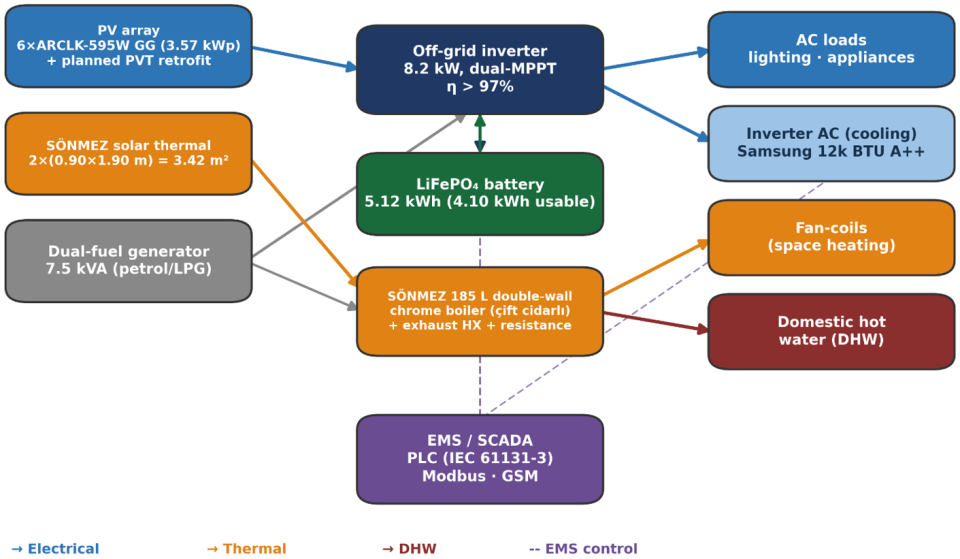
The 6 February 2023 Kahramanmaraş earthquakes (Mw 7.7 and Mw 7.6) left more than three million people homeless in Türkiye and, as of February 2025, over 649,000 people still reside in container settlements, for which reliable grid-independent energy provision remains an unsolved challenge. This paper presents the integrated design, first- and second law (energy and exergy) thermodynamic analysis, annual simulation, and techno-economic and environmental assessment of a mobile hybrid energy production, storage, and management system built for a 21 m² disaster-relief container home in Ankara (39.93°N), using commercially procured equipment. The system couples a 3.57 kWp array of six 595W glass–glass modules, with a planned roll-bond photovoltaic–thermal retrofit, a 5.12 kWh LiFePO₄ battery, an 8.2 kW dual-MPPT inverter, a 7.5 kVA dual-fuel generator with exhaust heat recovery, a 3.42 m² aluminium flat-plate solar-thermal field charging a 185 L (net) double-wall chromium boiler for domestic hot water and supplementary heating, and a single 12,000 BTU A++ inverter air conditioner dedicated to cooling (heat-pump heating retained only as emergency backup), all under a PLC-based EMS/SCADA. A 35° sawtooth mounting structure is designed, and its tilt optimization and inter-row shading are analyzed under the constraint of a 3 m roof depth. The annual electricity yield is 4,430 kWh (parallel-mounted), rising to 4,960 kWh at the 35° optimum, against ~1,740 kWh electrical demand, giving full summer autonomy and 60–85 h of winter generator run-time. The combined first-law efficiency reaches 68% in cogeneration mode; the overall second-law efficiency is ~24% (sustainability index 1.32), the low-temperature collector and the indirect double-wall boiler being the principal exergy-destruction sites. Against a continuous generator baseline, the system pays back in ~6 years and avoids ~2,770 kg CO₂/yr (~69 t over 25 years).
- AFAD (Disaster and Emergency Management Authority). 2023 Kahramanmaraş (Pazarcık and Elbistan) Earthquakes Report. Ankara: AFAD; 2023. www.sbb.gov.tr/wp-content/uploads/2023/03/2023-Kahramanmaras-and-Hatay-Earthquakes-Report.pdf
- Republic of Türkiye, Presidency Directorate of Communications / AFAD. Integrated Disaster Management-Efforts in the Earthquake Zone (status report, February 2025). Ankara; 2025.
- International Energy Agency. Emissions Factors 2025 — Database Documentation. Paris: IEA; 2025. (Türkiye grid CO₂ factor ≈ 0.4–0.5 kg CO₂/kWh).
- Poredoš P, Tomc U, Petelin N, Vidrih B, Flisar U, Kitanovski A. Numerical and experimental investigation of the energy and exergy performance of solar thermal, photovoltaic and photovoltaic–thermal modules based on roll-bond heat exchangers. Energy Convers Manag. 2020;210:112674. https://doi.org/10.1016/j.enconman.2020.112674
- Çiftçi E, Khanlari A, Sözen A, Aytaç İ, Tuncer AD. Energy and exergy analysis of a photovoltaic thermal (PVT) system used in solar dryer: a numerical and experimental investigation. Renew Energy. 2021;180:410–423. https://doi.org/10.1016/j.renene.2021.08.081
- Hoarcă IC, Bizon N, Șorlei IS, Thounthong P. Sizing design for a hybrid renewable power system using HOMER and iHOGA simulators. Energies. 2023;16(4):1926. https://doi.org/10.3390/en16041926
- Mohamed MA, et al. Techno-economic and environmental analysis of a fully renewable hybrid energy system for sustainable power infrastructure. Sci Rep. 2025;15. https://doi.org/10.1038/s41598-025-96401-z
- Kallio S, Siroux M. Exergy and exergy-economic approach to evaluate hybrid renewable energy systems in buildings. Energies. 2023;16(3):1029. https://doi.org/10.3390/en16031029
- Petela R. Exergy of undiluted thermal radiation. Sol Energy. 2003;74(6):469–488. https://doi.org/10.1016/S0038-092X(03)00226-3
- Caliskan H. Energy, exergy, environmental, enviroeconomic, exergoenvironmental (EXEN) and exergoenviroeconomic (EXENEC) analyses of solar collectors. Renew Sustain Energy Rev. 2017;69:488–492. https://doi.org/10.1016/j.rser.2016.11.203
- Tashtoush B, Morosuk T, Chudasama J. Exergy and exergoeconomic analysis of a cogeneration hybrid solar organic Rankine cycle with ejector. Entropy. 2020;22(6):702. https://doi.org/10.3390/e22060702
- Tillmann P, Jäger K, Becker C. Minimising the levelised cost of electricity for bifacial solar panel arrays using Bayesian optimisation. Sustain Energy Fuels. 2020;4(1):254–264. https://doi.org/10.1039/C9SE00750D
- Preger Y, Barkholtz HM, Fresquez A, Campbell DL, Juba BW, Román-Kustas J, Ferreira SR, Chalamala B. Degradation of commercial lithium-ion cells as a function of chemistry and cycling conditions. J Electrochem Soc. 2020;167(12):120532. https://doi.org/10.1149/1945-7111/abae37
- Olmos J, Gandiaga I, Saez-de-Ibarra A, Larrea X, Nieva T, Aizpuru I. Modelling the cycling degradation of Li-ion batteries: chemistry influenced stress factors. J Energy Storage. 2021;40:102765. https://doi.org/10.1016/j.est.2021.102765
- Sayfutdinov T, Vorobev P. Optimal utilization strategy of the LiFePO₄ battery storage. Appl Energy. 2022;316:119080. https://doi.org/10.1016/j.apenergy.2022.119080
- Naumann M, Spingler FB, Jossen A. Analysis and modeling of cycle aging of a commercial LiFePO₄/graphite cell. J Power Sources. 2020;451:227666. https://doi.org/10.1016/j.jpowsour.2019.227666
- Zafra RG, Mayo JRM, Villareal PJM, De Padua VMN, Castillo MHT, Sundo MB, Madlangbayan MS. Structural and thermal performance assessment of shipping container as post-disaster housing in tropical climates. Civ Eng J. 2021;7(8):1437–1458. https://doi.org/10.28991/cej-2021-03091735
- Noaman DS, El-Ghafour SA. Holistic design of energy-efficient temporary houses: meeting ventilation, heating, cooling and lighting demands. J Build Eng. 2024;86:108534. https://doi.org/10.1016/j.jobe.2024.108534
- Tanyer AM, Tavukcuoglu A, Bekboliev M. Assessing the airtightness performance of container houses in relation to its effect on energy efficiency. Build Environ. 2018;134:59–73. https://doi.org/10.1016/j.buildenv.2018.02.026
- Tong Y, Yang H, Bao L, Guo B, Shi Y, Wang C. Analysis of thermal insulation thickness for a container house in the Yanqing zone of the Beijing 2022 Winter Games. Int J Environ Res Public Health. 2022;19(24):16417. https://doi.org/10.3390/ijerph192416417
- Mauro A, et al. Climate characterization and energy efficiency in container housing: implications for container house design in European locations. Energies. 2024;17(12):2926. https://doi.org/10.3390/en17122926