Long-term dynamics and future trajectories of natural gas production: a global, regional, and Iranian assessment
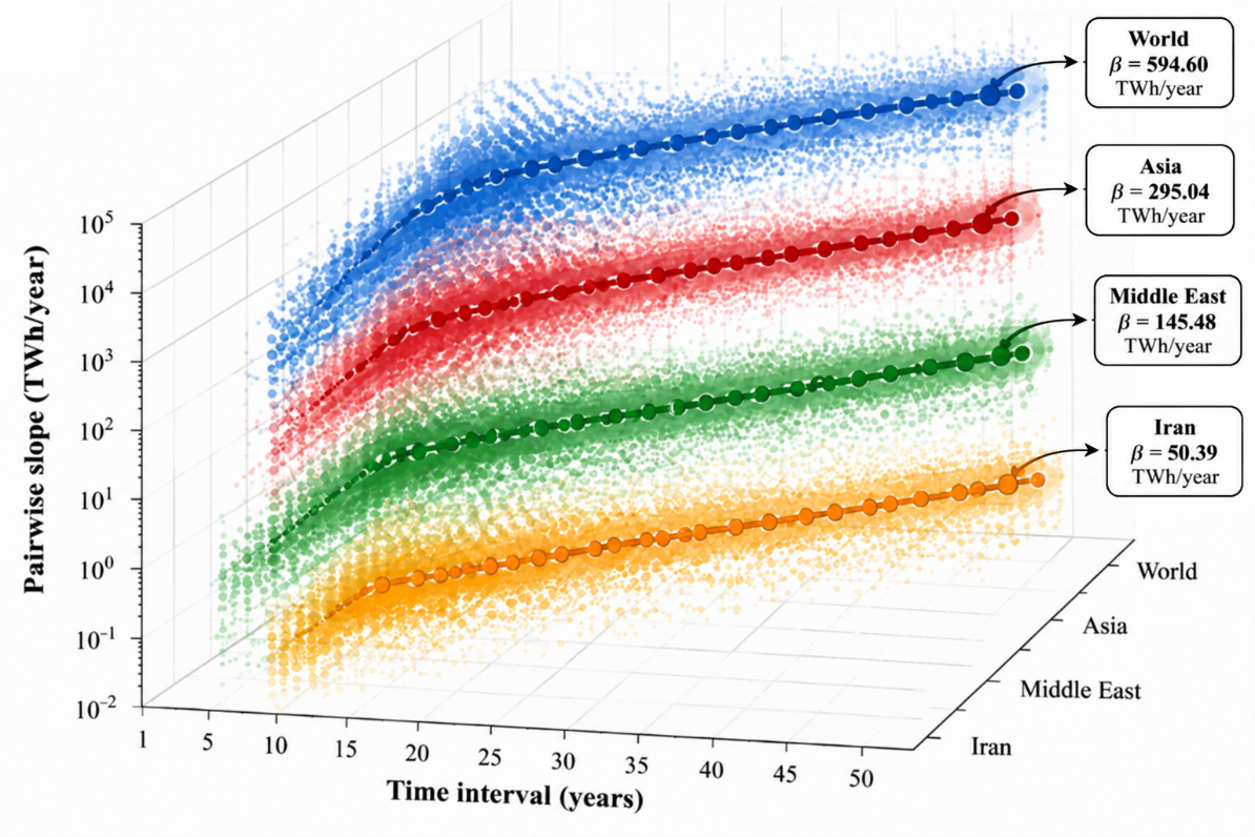
Natural gas plays an important role in sustainable energy supply and future planning. This study examines trends in global natural gas production, Asia, the Middle East, and Iran, and outlines its outlook using several analytical methods. Annual data for the period 1970-2025 were examined using trend analysis and time series forecasting methods. The significance of trends was determined using the Mann–Kendall test, and the rate of change was determined using Sen’s slope estimator. Then, an ARIMA model was developed to forecast production up to 2035, and its accuracy was evaluated using RMSE, MAE, and MAPE criteria. The results showed that production increased in all four ranges and was statistically significant (p < 0.001). The Z-statistic values were between 9.69 and 10.83. Sen’s slope estimates showed annual increases in production in the world, Asia, the Middle East, and Iran of 594.60, 295.04, 145.48, and 50.39 TWh/year, respectively. The ARIMA forecast also indicated that this increase would continue until 2035. Global production would increase from 41,964.71 TWh in 2025 to about 48,159.54 TWh. Production in Asia, the Middle East, and Iran in 2035 was also predicted to be about 18,096.72, 9,348.25, and 3,305.26 TWh, respectively. MAPE values below 10% indicate the model's accuracy in representing historical production behavior. By examining trend significance, estimating growth rates, and forecasting, we can better understand long-term changes in natural gas production.
- Saifoddin, A., Gholamalipour, A., & Shirazi, M. A. (2026). Petrochemical export taxation as energy-industrial policy in Iran: a product-specific value-chain analysis. Future Energy, 5(4), 1-11.
- Yang, Z., Zhu, Y. W., Li, N., Chen, G. Q., Yin, Y. B., Ma, T. M., & Liu, H. Q. (2026). Sustainable ethylene production: A life cycle perspective on oil, coal, and natural gas derived industrial pathways in China. Journal of Cleaner Production, 538, 147359.
- Wang, Q., Sun, Z., Guo, J., & Li, R. (2023). The more effective option to combat environmental degradation: Energy efficiency vs. renewable energy vs. natural gas?. Energy, 283, 128512.
- Sen, D., Hamurcuoglu, K. I., Ersoy, M. Z., Tunç, K. M., & Günay, M. E. (2023). Forecasting long-term world annual natural gas production by machine learning. Resources Policy, 80, 103224.
- Wang, J., & Bentley, Y. (2020). Modelling world natural gas production. Energy Reports, 6, 1363-1372.
- Abualoyoun, O. S., & Amar, A. A. (2025). Toward achieving net-zero in the evolution of the global energy sector. Int. J. Electr. Eng. Sustain., 3(1), 143-156.
- Ebrahimizaker, S., Shirazi, M. A., Farahani, A. J., Ghabaei, A., Mousavi, S. M., & Yousefi, H. (2026). Global review of the ISO 50001 standard and provision of a framework for improving energy management systems for Iran. Future Energy, 5(3), 25-49.
- Wang, Q., Li, S., Li, R., & Ma, M. (2018). Forecasting US shale gas monthly production using a hybrid ARIMA and metabolic nonlinear grey model. Energy, 160, 378-387.
- GSH, G. S. H. (2018). Gas Market Report. change, 7(142), 7-47. https://www.aer.gov.au/system/files/AER%20gas%20weekly%20report%20-%201%20%E2%80%93%207%20July%202018_1.pdf
- Kondratov, D. I. (2022). The global gas market: Modern trends and development prospects. Herald of the Russian Academy of Sciences, 92(2), 188-198.
- Wang, Q., & Jiang, F. (2019). Integrating linear and nonlinear forecasting techniques based on grey theory and artificial intelligence to forecast shale gas monthly production in Pennsylvania and Texas of the United States. Energy, 178, 781-803.
- Qiao, W., Liu, W., & Liu, E. (2021). A combination model based on wavelet transform for predicting the difference between monthly natural gas production and consumption of US. Energy, 235, 121216.
- Suganthi, L., & Samuel, A. A. (2012). Energy models for demand forecasting—A review. Renewable and sustainable energy reviews, 16(2), 1223-1240.
- Ediger, V. Ş., Akar, S., & Uğurlu, B. (2006). Forecasting production of fossil fuel sources in Turkey using a comparative regression and ARIMA model. Energy Policy, 34(18), 3836-3846.
- Azadeh, A. G. H. A. D. E. R. I., Ghaderi, S. F., & Sohrabkhani, S. (2008). Annual electricity consumption forecasting by neural network in high energy consuming industrial sectors. Energy Conversion and management, 49(8), 2272-2278.
- Manigandan, P., Alam, M. S., Alharthi, M., Khan, U., Alagirisamy, K., Pachiyappan, D., & Rehman, A. (2021). Forecasting natural gas production and consumption in United States-evidence from SARIMA and SARIMAX models. Energies, 14(19), 6021.
- Yucesan, M., Pekel, E., Celik, E., Gul, M., & Serin, F. (2025). Forecasting daily natural gas consumption with regression, time series and machine learning based methods. Energy Sources, Part A: Recovery, Utilization, and Environmental Effects, 47(1), 4605-4620.
- Qiao, W., Li, Z., Liu, W., & Liu, E. (2022). Fastest‐growing source prediction of US electricity production based on a novel hybrid model using wavelet transform. International Journal of Energy Research, 46(2), 1766-1788.
- Alakent, B., Isikli, E., Kadaifci, C., & Taspinar, T. S. (2025). Forecasting Monthly Residential Natural Gas Demand Using Just-In-Time-Learning Modeling. arXiv preprint arXiv:2502.20989.
- Koc, T., Dunder, E., & Koç, H. (2024). Forecasting of natural gas supplied for EU in Gazprom with ARIMA and machine learning methods. International Journal of Data Science and Applications, 7(1), 39-47.
- Firoozeh, M., Dashti, N., & Hatefi, M. A. (2025). Hybrid Deep Learning Modeling Approach to Predict Natural Gas Consumption of Home Subscribers on Limited Data. arXiv preprint arXiv:2510.02115.
- Sung, J., Shi, X., Teske, S., & Li, M. (2025). A hybrid SARIMAX-LSTM model optimised by ANN for near-term forecasting: An application to China’s natural gas consumption. https://opus.lib.uts.edu.au/bitstream/10453/187869/2/CCRR_WPS_2025%281%29_Sung%20et%20al.pdf
- Du, P., Zhang, X. K., Du, J. T., & Wang, J. Z. (2025). Multivariate natural gas price forecasting model with feature selection, machine learning and chernobyl disaster optimizer. Petroleum Science. DOI: 10.1016/j.petsci.2025.09.034
- Salisu, A. A., Ogbonna, A. E., Gupta, R., & Polat, O. (2026). Forecasting Natural Gas Futures Price Volatility of the United States: National Versus State‐Level Climate Concern Indexes. Journal of Futures Markets, 46(7), 1275-1297.
- Zou, C., Zhao, Q., Chen, J., Li, J., Yang, Z., Sun, Q., ... & Zhang, G. (2018). Natural gas in China: Development trend and strategic forecast. Natural Gas Industry B, 5(4), 380-390.
- Pu, Y., Zhu, C., Yao, G., Yang, K., Yang, Q., & Chen, C. P. (2026). Interval forecast of natural gas daily consumption based on spatial–temporal Bayesian model. Advanced Engineering Informatics, 72, 104426.
- Liu, J., Wang, S., Wei, N., Chen, X., Xie, H., & Wang, J. (2021). Natural gas consumption forecasting: A discussion on forecasting history and future challenges. Journal of Natural Gas Science and Engineering, 90, 103930.
- Aag, R., Bjørnland, H. C., & Eliassen, P. (2026). Forecasting oil and natural gas prices: A model combination approach. International Journal of Forecasting. DOI: 10.1016/j.ijforecast.2026.07.007
- Panapakidis, I. P., & Dagoumas, A. S. (2017). Day-ahead natural gas demand forecasting based on the combination of wavelet transform and ANFIS/genetic algorithm/neural network model. Energy, 118, 231-245.
- Qiao, W., Ma, Q., Yang, Y., Xi, H., Huang, N., Yang, X., & Zhang, L. (2025). Natural gas consumption forecasting using a novel two-stage model based on improved sparrow search algorithm. Journal of Pipeline Science and Engineering, 5(1), 100220.
- Energy Institute – Statistical Review of World Energy (2026) – with major processing by Our World in Data. “Gas production” [dataset]. Energy Institute, “Statistical Review of World Energy”. https://static.foxnews.com/foxnews.com/content/uploads/2026/07/Statistical_Review_of_World_Energy__1_.pdf
- Hussain, M., & Mahmud, I. (2019). pyMannKendall: a python package for non parametric Mann Kendall family of trend tests. Journal of open source software, 4(39), 1556.
- Karmeshu, N. (2012). Trend detection in annual temperature & precipitation using the Mann Kendall test–a case study to assess climate change on select states in the northeastern United States (Doctoral dissertation, University of Pennsylvania). https://repository.upenn.edu/server/api/core/bitstreams/d7938cc8-3368-4d1c-9a4b-cece58db0cd6/content
- Din, R. U., Hussain, S., Khan, A. A., Anjum, M. N., Rahman, A. S., & Ullah, S. (2026). Assessing Nonstationary Hydroclimatic Impacts on Streamflow in the Soan River Basin, Pakistan, Using Mann–Kendall Test and Artificial Neural Network Technique. Hydrology, 13(4), 106.
- Moezzi, S. M., Shirazi, M. A., Monfared, A. R. Z., & Yousefi, H. (2026). Comparison of classical statistical models for forecasting CO₂ emissions, GDP, and TBL cancer indicators: A comparative analysis of East and West Asia. Energy Nexus, 21, 100682.
- Allahrabbi Shirazi, M., Fathi, A., Baneshi, M., & Yousefi, H. (2026). Energy-Free Fog Water Harvesting: Impact of Mesh Material and Aperture Size on Efficiency and Cost. Environmental Energy and Economic Research, 10(2), eS128.
- Saifoddin, A., Gholizadeh, M. H., & Allahrabbi Shirazi, M. (2026). Integrated analysis of advanced applications of artificial intelligence (AI) in modern energy systems. Journal of sustainable Energy Systems, 5(2), 297-327.
- Allahrabbi Shirazi, M. A., Goldoust, A., Khatami, M., Abedi, E., & Janfeshan, M. H. (2024). Modeling and simulation of a solar tracker with bifacial panel: a case study of Tehran city. Journal of Sustainable Energy Systems, 3(3), 271-287.
- Malakouti, M. (2026). Machine learning for renewable energy forecasting: advances, challenges, and future directions. Sustainable Energy Research, 13(1), 14.