Physicochemical characterization and FTIR analysis of pyrolysis oil derived from waste tires
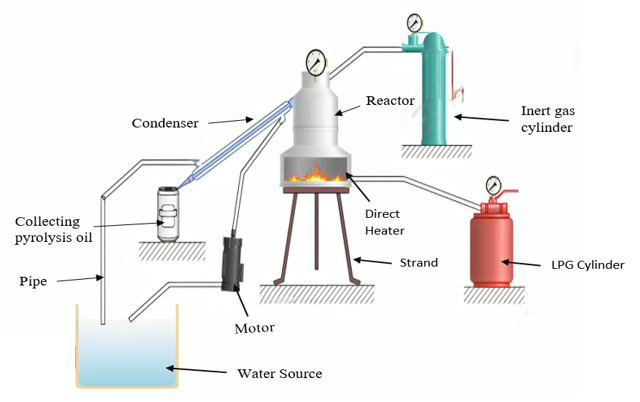
Waste tire pyrolysis has emerged as a promising thermochemical conversion technology for recovering valuable liquid fuels while addressing the environmental challenges associated with end-of-life tires. For this purpose, tire-derived fuel was pyrolyzed in a fixed-bed reactor at varying temperatures of 560 °C, 565 °C, 580 °C, 590 °C, and 600 °C. The maximum pyrolytic oil yield was achieved at 600 °C, producing approximately 45.56% liquid, 22.44% gas, and 32% solid residue. Increasing the temperature improved oil yield while reducing gas output. The physicochemical properties analyzed for the pyrolytic oil include calorific value, viscosity, density, flash point, fire point, and elemental composition. Fourier Transform Infrared Spectroscopy (FT-IR) analysis revealed various functional groups, including alkanes, alkenes, aromatics, and carbonyl compounds, indicating a complex hydrocarbon mixture. Thus, this study aims to produce tire pyrolysis oil (TPO) and assess its suitability as an alternative fuel for IC engines through yield analysis and fuel property characterization.
- O. E. Ajala, F. Aberuagba, T. E. Odetoye, and A. M. Ajala, “Biodiesel: Sustainable Energy Replacement to Petroleum‐Based Diesel Fuel – A Review,” ChemBioEng Rev., vol. 2, no. 3, pp. 145–156, Jun. 2015, doi: 10.1002/cben.201400024.
- G. A. Mansoori et al., “Fuels of the Future for Renewable Energy Sources (Ammonia, Biofuels, Hydrogen),” 2021, arXiv. doi: 10.48550/ARXIV.2102.00439.
- N. H. Zerin, M. G. Rasul, M. I. Jahirul, and A. S. M. Sayem, “End-of-life tyre conversion to energy: A review on pyrolysis and activated carbon production processes and their challenges,” Sci. Total Environ., vol. 905, p. 166981, Dec. 2023, doi: 10.1016/j.scitotenv.2023.166981.
- B. S. Chauhan, R. K. Singh, H. M. Cho, and H. C. Lim, “Practice of diesel fuel blends using alternative fuels: A review,” Renew. Sustain. Energy Rev., vol. 59, pp. 1358–1368, 2016.
- How Many Truckers Are in the US? A Deep Dive into the American Trucking Industry. Website: https://www.rapidresponsestl.com/how-many-truckers-are-in-the-us/ (August 2026)
- M. I. Arbab, H. H. Masjuki, M. Varman, M. A. Kalam, S. Imtenan, and H. Sajjad, “Fuel properties, engine performance and emission characteristic of common biodiesels as a renewable and sustainable source of fuel,” Renew. Sustain. Energy Rev., vol. 22, pp. 133–147, 2013.
- A. K. Agarwal, T. Gupta, and A. Kothari, “Particulate emissions from biodiesel vs diesel fuelled compression ignition engine,” Renew. Sustain. Energy Rev., vol. 15, no. 6, pp. 3278–3300, 2011.
- M. Staff, “43% of US Commercial Trucks Powered by Diesel,” MHL News. Accessed: Jul. 19, 2026. [Online]. Available: https://www.mhlnews.com/transportation-distribution/article/22055876/43-of-us-commercial-trucks-powered-by-diesel
- “Use of diesel - U.S. Energy Information Administration (EIA).” Accessed: Jul. 19, 2026. [Online]. Available: https://www.eia.gov/energyexplained/diesel-fuel/use-of-diesel.php
- “The percentage of commercial diesel trucks that are near-zero emissions grows.” Accessed: Jul. 19, 2026. [Online]. Available: https://www.fleetequipmentmag.com/57-of-all-commercial-diesel-trucks-on-the-roads-are-near-zero-emissions-models/
- S. Boxiong, W. Chunfei, L. Cai, G. Binbin, and W. Rui, “Pyrolysis of waste tyres: The influence of USY catalyst/tyre ratio on products,” J. Anal. Appl. Pyrolysis, vol. 78, no. 2, pp. 243–249, Mar. 2007, doi: 10.1016/j.jaap.2006.07.004.
- B. S. Thomas and R. Chandra Gupta, “Properties of high strength concrete containing scrap tire rubber,” J. Clean. Prod., vol. 113, pp. 86–92, Feb. 2016, doi: 10.1016/j.jclepro.2015.11.019.
- S. Doja, L. K. Pillari, and L. Bichler, “Processing and activation of tire-derived char: A review,” Renew. Sustain. Energy Rev., vol. 155, p. 111860, Mar. 2022, doi: 10.1016/j.rser.2021.111860.
- “Federal Register, Volume 65 Issue 107 (Friday, June 2, 2000).” Accessed: Jul. 19, 2026. [Online]. Available: https://www.govinfo.gov/content/pkg/FR-2000-06-02/html/00-12952.htm
- J. Xu et al., “High-value utilization of waste tires: A review with focus on modified carbon black from pyrolysis,” Sci. Total Environ., vol. 742, p. 140235, Nov. 2020, doi: 10.1016/j.scitotenv.2020.140235.
- P. Lahijani, Z. A. Zainal, A. R. Mohamed, and M. Mohammadi, “Co-gasification of tire and biomass for enhancement of tire-char reactivity in CO2 gasification process,” Bioresour. Technol., vol. 138, pp. 124–130, Jun. 2013, doi: 10.1016/j.biortech.2013.03.179.
- M. Nehdi and A. Khan, “Cementitious Composites Containing Recycled Tire Rubber: An Overview of Engineering Properties and Potential Applications,” Cem. Concr. Aggreg., vol. 23, no. 1, pp. 3–10, Jun. 2001, doi: 10.1520/CCA10519J.
- J. Zhang, I. Jones, M. Zhu, Z. Zhang, J. Preciado-Hernandez, and D. Zhang, “Pore Development During CO2 and Steam Activation of a Spent Tyre Pyrolysis Char,” Waste Biomass Valorization, vol. 12, no. 4, pp. 2097–2108, Apr. 2021, doi: 10.1007/s12649-020-01165-4.
- I. Hita, M. Arabiourrutia, M. Olazar, J. Bilbao, J. M. Arandes, and P. Castaño, “Opportunities and barriers for producing high quality fuels from the pyrolysis of scrap tires,” Renew. Sustain. Energy Rev., vol. 56, pp. 745–759, Apr. 2016, doi: 10.1016/j.rser.2015.11.081.
- A. J. Bowles and G. D. Fowler, “Assessing the impacts of feedstock and process control on pyrolysis outputs for tyre recycling,” Resour. Conserv. Recycl., vol. 182, p. 106277, Jul. 2022, doi: 10.1016/j.resconrec.2022.106277.
- Z. Derakhshan et al., “A new recycling technique for the waste tires reuse,” Environ. Res., vol. 158, pp. 462–469, Oct. 2017, doi: 10.1016/j.envres.2017.07.003.
- J. D. Martínez, N. Puy, R. Murillo, T. García, M. V. Navarro, and A. M. Mastral, “Waste tyre pyrolysis – A review,” Renew. Sustain. Energy Rev., vol. 23, pp. 179–213, Jul. 2013, doi: 10.1016/j.rser.2013.02.038.
- E. L. K. Mui, D. C. K. Ko, and G. McKay, “Production of active carbons from waste tyres––a review,” Carbon, vol. 42, no. 14, pp. 2789–2805, 2004, doi: 10.1016/j.carbon.2004.06.023.
- P. T. Williams, “Pyrolysis of waste tyres: A review,” Waste Manag., vol. 33, no. 8, pp. 1714–1728, Aug. 2013, doi: 10.1016/j.wasman.2013.05.003.
- “The percentage of commercial diesel trucks that are near-zero emissions grows.” Accessed: Jul. 19, 2026. [Online]. Available: https://www.fleetequipmentmag.com/57-of-all-commercial-diesel-trucks-on-the-roads-are-near-zero-emissions-models/
- “More of America’s Truck and Bus Fleets Powered by Advanced.” Accessed: Jul. 19, 2026. [Online]. Available: https://www.globenewswire.com/news-release/2026/05/06/3288779/0/en/More-of-America-s-Truck-and-Bus-Fleets-Powered-by-Advanced-Diesel-Engines-Than-Ever-Before.html
- E. T. Forum, “More of America’s Truck and Bus Fleets Powered by Advanced Diesel Engines Than Ever Before,” GlobeNewswire News Room. Accessed: Jul. 19, 2026. [Online]. Available: https://www.globenewswire.com/news-release/2026/05/06/3288779/0/en/More-of-America-s-Truck-and-Bus-Fleets-Powered-by-Advanced-Diesel-Engines-Than-Ever-Before.html
- “The percentage of commercial diesel trucks that are near-zero emissions grows.” Accessed: Jul. 19, 2026. [Online]. Available: https://www.fleetequipmentmag.com/57-of-all-commercial-diesel-trucks-on-the-roads-are-near-zero-emissions-models/
- E. T. Forum, “More of America’s Truck and Bus Fleets Powered by Advanced Diesel Engines Than Ever Before,” GlobeNewswire News Room. Accessed: Jul. 19, 2026. [Online]. Available: https://www.globenewswire.com/news-release/2026/05/06/3288779/0/en/More-of-America-s-Truck-and-Bus-Fleets-Powered-by-Advanced-Diesel-Engines-Than-Ever-Before.html
- G. Zhang et al., “Properties and utilization of waste tire pyrolysis oil: A mini review,” Fuel Process. Technol., vol. 211, p. 106582, Jan. 2021, doi: 10.1016/j.fuproc.2020.106582.
- S. Mirmiran, H. Pakdel, and C. Roy, “Characterization of used tire vacuum pyrolysis oil: nitrogenous compounds from the naphtha fraction,” J. Anal. Appl. Pyrolysis, vol. 22, no. 3, pp. 205–215, 1992.
- M. F. Laresgoiti, B. M. Caballero, I. De Marco, A. Torres, M. A. Cabrero, and M. J. Chomón, “Characterization of the liquid products obtained in tyre pyrolysis,” J. Anal. Appl. Pyrolysis, vol. 71, no. 2, pp. 917–934, 2004, doi: 10.1016/j.jaap.2003.12.003.
- P. Rathsack, A. Rieger, R. Haseneder, D. Gerlach, J.-U. Repke, and M. Otto, “Analysis of pyrolysis liquids from scrap tires using comprehensive gas chromatography–mass spectrometry and unsupervised learning,” J. Anal. Appl. Pyrolysis, vol. 109, pp. 234–243, 2014.
- A. M. Cunliffe and P. T. Williams, “Composition of oils derived from the batch pyrolysis of tyres,” J. Anal. Appl. Pyrolysis, vol. 44, no. 2, pp. 131–152, 1998.
- C. İlkılıç and H. Aydın, “Fuel production from waste vehicle tires by catalytic pyrolysis and its application in a diesel engine,” Fuel Process. Technol., vol. 92, no. 5, pp. 1129–1135, May 2011, doi: 10.1016/j.fuproc.2011.01.009.
- S. Murugan, M. C. Ramaswamy, and G. Nagarajan, “Performance, emission and combustion studies of a DI diesel engine using Distilled Tyre pyrolysis oil-diesel blends,” Fuel Process. Technol., vol. 89, no. 2, pp. 152–159, 2008, doi: 10.1016/j.fuproc.2007.08.005.
- A. Sharma and S. Murugan, “Potential for using a tyre pyrolysis oil-biodiesel blend in a diesel engine at different compression ratios,” Energy Convers. Manag., vol. 93, pp. 289–297, 2015.
- M. Karagöz, “Investigation of performance and emission characteristics of an CI engine fuelled with diesel–waste tire oil–butanol blends,” Fuel, vol. 282, p. 118872, 2020.
- S.-Q. Li, Q. Yao, Y. Chi, J.-H. Yan, and K.-F. Cen, “Pilot-scale pyrolysis of scrap tires in a continuous rotary kiln reactor,” Ind. Eng. Chem. Res., vol. 43, no. 17, pp. 5133–5145, 2004.
- M. R. Islam, M. Tushar, and H. Haniu, “Production of liquid fuels and chemicals from pyrolysis of Bangladeshi bicycle/rickshaw tire wastes,” J. Anal. Appl. Pyrolysis, vol. 82, no. 1, pp. 96–109, 2008.
- S. Ucar, S. Karagoz, A. R. Ozkan, and J. Yanik, “Evaluation of two different scrap tires as hydrocarbon source by pyrolysis,” Fuel, vol. 84, no. 14–15, pp. 1884–1892, 2005.
- P. T. Williams, R. P. Bottrill, and A. M. Cunliffe, “Combustion of tyre pyrolysis oil,” Process Saf. Environ. Prot., vol. 76, no. 4, pp. 291–301, 1998.
- R. N. Pote and R. K. Patil, “Combustion and emission characteristics analysis of waste tyre pyrolysis oil,” SN Appl. Sci., vol. 1, no. 4, p. 294, Apr. 2019, doi: 10.1007/s42452-019-0308-8.
- S. Hariharan, S. Murugan, and G. Nagarajan, “Effect of diethyl ether on Tyre pyrolysis oil fueled diesel engine,” Fuel, vol. 104, pp. 109–115, Feb. 2013, doi: 10.1016/j.fuel.2012.08.041.
- A. Uyumaz et al., “Production of waste tyre oil and experimental investigation on combustion, engine performance and exhaust emissions,” J. Energy Inst., vol. 92, no. 5, pp. 1406–1418, Oct. 2019, doi: 10.1016/j.joei.2018.09.001.
- “Diesel Engines Market 2025 to 2032.” Accessed: Jul. 19, 2026. [Online]. Available: https://www.intelmarketresearch.com/diesel-engines-market-14196
- S. Murugan, H. Sundaramoorthi, G. Nagarajan, and B. Horak, “A comparative study on some methods to use tyre pyrolysis oil as an alternative fuel in a DI diesel engine,” Exergy Better Environ. Improv. Sustain. 2 Appl., pp. 405–420, 2018.
- U. Ž. Baškovič, T. Seljak, and T. Katrašnik, “Combustion and emission formation phenomena of tire pyrolysis oil in a common rail Diesel engine,” Energy Convers. Manag., vol. 149, pp. 706–721, 2017.
- R. N. Pote and R. K. Patil, “Combustion and emission characteristics analysis of waste tyre pyrolysis oil,” SN Appl. Sci., vol. 1, no. 4, p. 294, Apr. 2019, doi: 10.1007/s42452-019-0308-8.
- S. V. Ghadge and H. Raheman, “Biodiesel production from mahua (Madhuca indica) oil having high free fatty acids,” Biomass Bioenergy, vol. 28, no. 6, pp. 601–605, 2005.