Performance comparison of ML algorithms for liver disease prediction
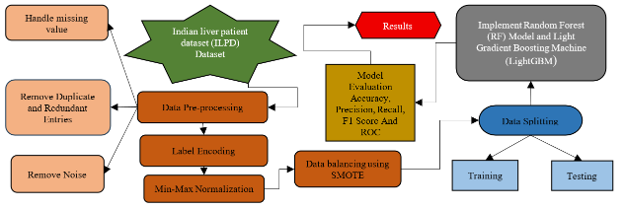
Liver disease is a leading cause of mortality throughout the world. Numerous lives may be saved if it can be detected in its early stages. Therefore, early detection of liver disease is crucial. This study aims to find a reliable ML model that can predict liver disease development using demographic and clinical data. This research explores several ML methods and introduces the most promising ones, Random Forest (RF) and Light Gradient Boosting Machine (LightGBM), for classification. The Indian Liver Patient Dataset (ILPD) is preprocessed by encoding categorical data, imputing missing values, removing duplicates and noise, applying Min-Max scaling, and balancing the data with SMOTE; this yields a dataset of 583 cases with 11 clinical and demographic characteristics. Models are assessed using F1-score, recall, accuracy, and precision, with an 80:20 stratified train-test split. While the proposed LightGBM model achieves a 99.8% ACC rate, a 99.9% PRE rate, a 99.5% REC rate, and a 99.8% F1-score (F1), the experimental results show that the RF model achieves a 99.6% PRE rate, a 99.7% REC rate, and a 99.6% F1-score (F1). The findings confirm that the proposed models achieved high ACC and reliability in predicting liver disease, with LightGBM delivering the highest ACC and PRE.
- M. D. Leise, W. R. Kim, W. K. Kremers, J. J. Larson, J. T. Benson, and T. M. Therneau, “A Revised Model for End-Stage Liver Disease Optimizes Prediction of Mortality Among Patients Awaiting Liver Transplantation,” Gastroenterology, vol. 140, no. 7, pp. 1952–1960, Jun. 2011, doi: 10.1053/j.gastro.2011.02.017.
- C.-C. Wu et al., “Prediction of fatty liver disease using machine learning algorithms,” Comput. Methods Programs Biomed., vol. 170, pp. 23–29, Mar. 2019, doi: 10.1016/j.cmpb.2018.12.032.
- M. Abdar, M. Zomorodi-Moghadam, R. Das, and I.-H. Ting, “Performance analysis of classification algorithms on early detection of liver disease,” Expert Syst. Appl., vol. 67, pp. 239–251, Jan. 2017, doi: 10.1016/j.eswa.2016.08.065.
- H. Raj, N. G, A. Kodipalli, and T. Rao, “Prediction of Chronic Liver Disease Using Machine Learning Algorithms and Interpretation with SHAP Kernels,” in 2024 IEEE International Conference on Information Technology, Electronics and Intelligent Communication Systems (ICITEICS), IEEE, Jun. 2024, pp. 1–6. doi: 10.1109/ICITEICS61368.2024.10625550.
- J. S. Redman et al., “Utilizing Natural Language Processing (NLP) to Accurately Identify Fatty Liver Disease,” Gastroenterology, vol. 152, no. 5, p. S1115, Apr. 2017, doi: 10.1016/S0016-5085(17)33757-5.
- D. Wolfe, M. Gong, G. Han, T. R. Magee, M. G. Ross, and M. Desai, “Nutrient sensor–mediated programmed nonalcoholic fatty liver disease in low birthweight offspring,” Am. J. Obstet. Gynecol., vol. 207, no. 4, pp. 308.e1-308.e6, Oct. 2012, doi: 10.1016/j.ajog.2012.07.033.
- M. E. Haas et al., “Machine learning enables new insights into genetic contributions to liver fat accumulation,” Cell Genomics, vol. 1, no. 3, p. 100066, Dec. 2021, doi: 10.1016/j.xgen.2021.100066.
- S. N, P. K, C. A, and P. P, “Artificial Intelligence and Pharmaceutical Discovery: A Comprehensive Review of Methods, Applications, and Future Directions,” Int. J. Sci. Res., vol. 14, no. 8, p. 3, 2025, doi: 10.21275/SR25808215949.
- H. R. Singh and S. Rabi, “Study of morphological variations of liver in human,” Transl. Res. Anat., vol. 14, pp. 1–5, Mar. 2019, doi: 10.1016/j.tria.2018.11.004.
- H. Razavi, “Global Epidemiology of Viral Hepatitis,” Gastroenterol. Clin. North Am., vol. 49, no. 2, pp. 179–189, Jun. 2020, doi: 10.1016/j.gtc.2020.01.001.
- A. A. Syed, A. B. Shaik, S. Konatam, M. V. P. Kumar, and N. Gupta, “CNN-Based Analytical Approach for Liver Disease Classification and Prediction,” in 2025 3rd International Conference on Advancement in Computation & Computer Technologies (InCACCT), IEEE, Apr. 2025, pp. 682–685. doi: 10.1109/InCACCT65424.2025.11011283.
- S. Noor, S. A. AlQahtani, and S. Khan, “Chronic liver disease detection using ranking and projection-based feature optimization with deep learning,” AIMS Bioeng., vol. 12, no. 1, pp. 50–68, 2025, doi: 10.3934/bioeng.2025003.
- E. Dritsas, S. Alexiou, and K. Moustakas, “COPD Severity Prediction in Elderly with ML Techniques,” in Proceedings of the 15th International Conference on PErvasive Technologies Related to Assistive Environments, New York, NY, USA: ACM, Jun. 2022, pp. 185–189. doi: 10.1145/3529190.3534748.
- P. Ramaraj and M. Mittal, “Deep Learning Models for Automated Medical Imaging: Accuracy, Ethics, And Deployment Challenges,” Int. J. Artif. Intell. Deep Learn., vol. 2, no. 1, pp. 11–31, Jun. 2025, doi: 10.34218/IJAIDL_02_01_002.
- R. Singh, R. Sharma, S. Chaudhary, D. Yadav, J. Jain, and P. Kumar, “Performance Analysis of Liver Disease Prediction Using Supervised Machine Learning Classification Models,” in 2024 1st International Conference on Advanced Computing and Emerging Technologies (ACET), IEEE, Aug. 2024, pp. 1–6. doi: 10.1109/ACET61898.2024.10729935.
- A. Q. Md, S. Kulkarni, C. J. Joshua, T. Vaichole, S. Mohan, and C. Iwendi, “Enhanced Preprocessing Approach Using Ensemble Machine Learning Algorithms for Detecting Liver Disease,” Biomedicines, vol. 11, no. 2, p. 581, Feb. 2023, doi: 10.3390/biomedicines11020581.
- K. K. Mohammed, “A Survey on Digital Health Care Data Analysis Techniques for Developing Machine Learning Models,” Int. J. Sci. Eng. Technol., vol. 13, no. 5, October, pp. 1–6, 2025, doi: :10.5281/zenodo.17339813.
- T. Gidener, M. Yin, R. A. Dierkhising, A. M. Allen, R. L. Ehman, and S. K. Venkatesh, “Magnetic resonance elastography for prediction of long‐term progression and outcome in chronic liver disease: A retrospective study,” Hepatology, vol. 75, no. 2, pp. 379–390, Feb. 2022, doi: 10.1002/hep.32151.
- Y. Liu et al., “Early prediction of incident liver disease using conventional risk factors and gut-microbiome-augmented gradient boosting,” Cell Metab., vol. 34, no. 5, pp. 719-730.e4, May 2022, doi: 10.1016/j.cmet.2022.03.002.
- B. N, M. Sowmiya, M. A, K. S, L. K. S, and R. S, “Early-Stage Liver Tumor Prediction Using Ensemble Machine Learning on Clinical Data,” in 2026 IEEE Madhya Pradesh Section Conference (MPCON), IEEE, Mar. 2026, pp. 411–415. doi: 10.1109/MPCON69668.2026.11508382.
- M. Grandhi, D. Thirupathamma, K. Nageswara Rao, G. Padma Rao, R. Maranan, and S. Kaliappan, “Liver Disease Detection Model Using ML–Ensemble Approach With Interpolative Approach As Stacked Model,” in 2025 6th International Conference for Emerging Technology (INCET), IEEE, May 2025, pp. 1–8. doi: 10.1109/INCET64471.2025.11140233.
- S. Kumar and G. Gourav, “Improving Liver Disease Prediction Through Ensemble ML Methods,” in 2025 International Conference on Emerging Engineering Technologies and Applications (IC-EETA), IEEE, Nov. 2025, pp. 754–758. doi: 10.1109/IC-EETA66496.2025.11548371.
- S. Lakumarapu, R. Nithyanandhan, V. S. Bhargavi, A. T. P, N. M, and S. S. R, “Machine Learning Approaches for Liver Disease Prediction: A Comparative Analysis,” in 2024 5th International Conference on Electronics and Sustainable Communication Systems (ICESC), IEEE, Aug. 2024, pp. 159–164. doi: 10.1109/ICESC60852.2024.10689974.
- S. S. Shivaji Rao and K. Gangadhara Rao, “Diagnosis of Liver Disease Using ANN and ML Algorithms with Hyperparameter Tuning,” in 2024 2nd International Conference on Intelligent Data Communication Technologies and Internet of Things (IDCIoT), IEEE, Jan. 2024, pp. 629–634. doi: 10.1109/IDCIoT59759.2024.10467855.
- P. Verma, K. Deshmukh, and D. Krishnan, “Multiclass Classification of Liver Diseases using Optimized Machine Learning Classifiers,” in 2023 International Conference on Computational Intelligence and Knowledge Economy (ICCIKE), IEEE, Mar. 2023, pp. 461–466. doi: 10.1109/ICCIKE58312.2023.10131875.
- M. Minnoor and V. Baths, “Liver Disease Diagnosis Using Machine Learning,” in 2022 IEEE World Conference on Applied Intelligence and Computing (AIC), 2022, pp. 41–47. doi: 10.1109/AIC55036.2022.9848916.
- O. Eray, “Liver Disease Prediction Using Hybrid Feature Selection: A Comparative Analysis of Machine Learning Models,” Appl. Sci., vol. 16, no. 13, p. 6726, Jul. 2026, doi: 10.3390/app16136726.
- A. Srinithi 1N. Karthick, 2S. Gowshik, 3G. Saran, 4C.S. Natesan, “Liver Disease Prediction Using Machine Learning Models And Algorithm,” 10th Int. Conf. Adv. Comput. Commun. Syst. ICACCS 2024, vol. 12, no. 3, pp. 1426–1429, 2024, doi: 10.1109/ICACCS60874.2024.10717180.
- A. K. M. S. Rahman, F. M. Javed Mehedi Shamrat, Z. Tasnim, J. Roy, and S. A. Hossain, “A comparative study on liver disease prediction using supervised machine learning algorithms,” Int. J. Sci. Technol. Res., vol. 8, no. 11, pp. 419–422, 2019.
- S. M. Ganie, P. K. Dutta Pramanik, and Z. Zhao, “Improved liver disease prediction from clinical data through an evaluation of ensemble learning approaches,” BMC Med. Inform. Decis. Mak., vol. 24, no. 1, p. 160, Jun. 2024, doi: 10.1186/s12911-024-02550-y.
- R. Islam, A. Sultana, and M. N. Tuhin, “A comparative analysis of machine learning algorithms with tree-structured parzen estimator for liver disease prediction,” Healthc. Anal., vol. 6, p. 100358, Dec. 2024, doi: 10.1016/j.health.2024.100358.


