The application of artificial intelligence in large-scale high-end equipment manufacturing projects: the moderating effect on the relationship between corporate culture, advertising investment, and strategic management of Shandong SMEs
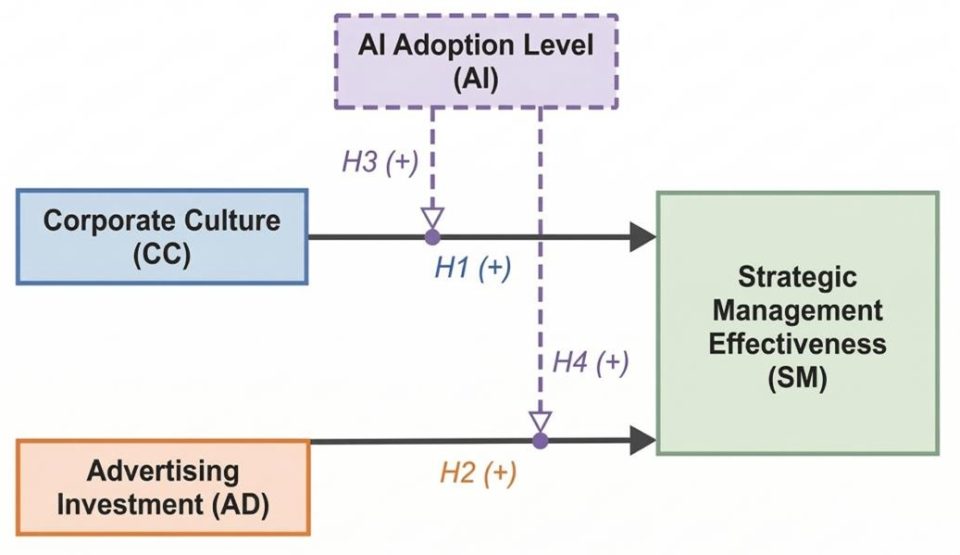
In view of the rapid development and penetration of artificial intelligence (AI) into the field of manufacturing, the strategic management of small and medium-sized enterprises (SMEs) in large-scale high-end equipment projects is undergoing a new transformation, yet previous studies have not taken artificial intelligence adoption as a boundary condition to examine the influence of corporate culture and advertising investment on strategic management effectiveness. Based on the Resource-Based View (RBV) and Contingency Theory, this study proposes a moderation model and tests it empirically. Questionnaires were distributed to 323 SME managers in Shandong Province, and hierarchical regression analysis and 5,000-resample bootstrapping were used to test the proposed model. The results show that all four hypotheses proposed in this study were verified. Corporate culture and advertising investment positively influence the effectiveness of strategic management. Artificial intelligence adoption plays a significant role in moderating these two relationships, and corporate culture is more important than advertising investment in this regard, since the interaction effect of corporate culture and artificial intelligence adoption on strategic management effectiveness is greater than that of advertising investment and artificial intelligence adoption. Under high levels of artificial intelligence adoption, the slope coefficient of corporate culture on strategic management effectiveness is 2.8 times that of low levels of artificial intelligence adoption. The study provides a new framework for strategic artificial intelligence management that integrates the RBV and Contingency Theory.
- E. Peretz-Andersson, V. Parida, and J. Wincent, "Artificial intelligence implementation in manufacturing SMEs: A resource orchestration approach," International Journal of Information Management, vol. 77, p. 102781, 2024. DOI: https://doi.org/10.1016/j.ijinfomgt.2024.102781.
- H. T. Truong, H. T. Dang, and C. V. Nguyen, "The influence of organizational culture, strategic vision development and competitive advantage on organizational performance in small and medium enterprises," Cogent Business & Management, vol. 12, no. 1, p. 2437146, 2025. DOI: https://doi.org/10.1080/23311975.2024.2437146.
- Y. Alsafadi and H. Y. Aljuhmani, "The influence of entrepreneurial innovations in building competitive advantage: The mediating role of entrepreneurial thinking," Kybernetes, vol. 53, no. 11, pp. 4051–4073, 2024. DOI: https://doi.org/10.1108/K-11-2022-1540
- K. Amoa-Gyarteng and S. Dhliwayo, "Cultivating success: Organizational culture's influence on innovation and performance in SMEs," Cogent Business & Management, vol. 11, no. 1, p. 2397070, 2024. DOI: https://doi.org/10.1080/23311975.2024.2397070.
- H. Alhawamdeh, M. Abdel Muhsen Irsheid Alafeef, M. Abdel Mohsen Al-Afeef, B. Y. Alkhawaldeh, M. Nawasra, H. A. A. Al_Rawashdeh, and G. N. Al-Eitan, "The relationship between marketing capabilities and financial performance: The moderating role of customer relationship management in Jordanian SMEs," Cogent Business & Management, vol. 11, no. 1, p. 2297458, 2024. DOI: https://doi.org/10.1080/23311975.2023.2297458.
- Y. Nassou and Z. Bennani, "Contingency theory in management: Conceptual phases and strategic link with performance measurement systems," European Journal of Arts, Humanities and Social Sciences, vol. 1, no. 3, pp. 183–187, 2024. DOI: https://doi.org/10.59324/ejahss.2024.1(3).16.
- A. Cimino, V. Corvello, C. Troise, and A. Ferraris, "Artificial intelligence adoption for sustainable growth in SMEs: An extended dynamic capability framework," Corporate Social Responsibility and Environmental Management, vol. 32, no. 5, pp. 6120–6138, 2025. DOI: https://doi.org/10.1002/csr.70019.
- Y. Fu, J. Ni, and M. Fang, "The impact of artificial intelligence on digital enterprise innovation," Journal of Strategy & Innovation, vol. 36, no. 1, p. 200538, 2025. DOI: https://doi.org/10.1016/j.jsinno.2025.200538.
- J. F. Hair, J. J. Risher, M. Sarstedt, and C. M. Ringle, "When to use and how to report the results of PLS-SEM," European Business Review, vol. 31, no. 1, pp. 2–24, 2019. DOI: https://doi.org/10.1108/EBR-11-2018-0203.
- A. F. Hayes, Introduction to Mediation, Moderation, and Conditional Process Analysis: A Regression-Based Approach, 3rd ed. New York, USA: The Guilford Press, 2022.
- D. Chen, J. P. Esperança, and S. Wang, "The impact of artificial intelligence on firm performance: An application of the resource-based view to e-commerce firms," Frontiers in Psychology, vol. 13, p. 884830, 2022. DOI: https://doi.org/10.3389/fpsyg.2022.884830.
- Z. Arabeche, A. Soudani, M. Brahmi, L. Aldieri, C. P. Vinci, and M. E. A. Abdelli, "Entrepreneurial orientation, organizational culture and business performance in SMEs: Evidence from emerging economy," Sustainability, vol. 14, no. 9, p. 5160, 2022. DOI: https://doi.org/10.3390/su14095160.


