Value co-creation in smart transportation new infrastructure projects: the mechanism of AI-enhanced corporate culture and advertising on strategic niche construction for Shandong SMEs
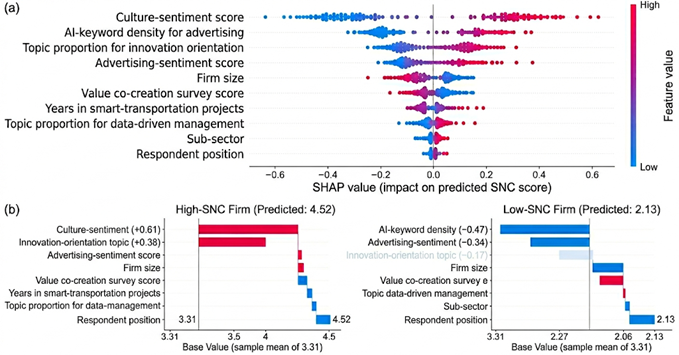
Small and medium-sized enterprises (SMEs) in China's smart-transportation new-infrastructure sector face persistent difficulties in constructing durable strategic niches, yet existing research relies on survey-based methods that overlook the textual signals firms produce through public-facing documents. This study proposes a three-stage analytical framework that integrates NLP feature extraction, machine-learning prediction, and PLS-SEM mediation testing. Drawing on 323 SMEs in Shandong Province and a corpus of 12,864 enterprise text segments, the NLP pipeline extracts culture-sentiment, advertising-sentiment, topic-proportion, and AI-keyword-density features through BERT-wwm-ext, LDA, and TF-IDF. XGBoost achieves the best prediction of strategic niche construction (R² = 0.63), and SHAP analysis identifies culture-sentiment as the top-ranked feature (mean |SHAP| = 0.42), outperforming all survey-derived variables. PLS-SEM validates that value co-creation partially mediates both paths from AI-enhanced organizational capabilities to niche construction (VAF = 29.3% and 31.7%). The findings indicate that text-derived indicators capture strategic positioning signals that conventional questionnaires miss, offering a replicable mixed-methods paradigm for AI-management crossover research.
- J. Zhang, S. Li, and Y. Wang, "Shaping a smart transportation system for sustainable value co-creation," Information Systems Frontiers, vol. 25, no. 1, pp. 365-380, 2023.
- S. Koch and S. Pasch, "CultureBERT: Measuring corporate culture with transformer-based language models," in 2023 IEEE International Conference on Big Data (BigData), pp. 3176-3184, 2023.
- T. Zhao, F. Zhang, G. Zhuo, Q. Zhang, and Q. Yuan, "The impact of digital intelligence technologies on innovation performance: Evidence from specialized, refined, differential and innovative enterprises," PLoS ONE, vol. 21, no. 2, e0339567, 2026.
- Y. Han, "Platform empowerment and SMEs niches base on different life cycles," Technology in Society, vol. 81, p. 102848, 2025.
- L. Hickman, S. Thapa, L. Tay, M. Cao, and P. Srinivasan, "Text preprocessing for text mining in organizational research: Review and recommendations," Organizational Research Methods, vol. 25, no. 1, pp. 114-146, 2022.
- M. Schachner, M. M. Ardag, P. Holtz, J. Großer, C. Hartz, H. van Herk, and H. Dobewall, "Extracting organizational culture from text: The development and validation of a theory-driven tool for digital data," European Journal of Work and Organizational Psychology, vol. 33, no. 5, pp. 571-582, 2024.
- H. Fang, G. Jiang, and D. Li, "Sentiment analysis based on Chinese BERT and fused deep neural networks for sentence-level Chinese e-commerce product reviews," Systems Science and Control Engineering, vol. 10, no. 1, pp. 802-810, 2022.
- Z. Jianfeng and Q. Tiantian, "Interpretable predictive model for listed companies ESG greenwashing based on XGBoost and SHAP," Scientific Reports, 2026.
- T. Schulz, H. Gewald, M. Böhm, and H. Krcmar, "Smart mobility: Contradictions in value co-creation," Information Systems Frontiers, vol. 25, no. 3, pp. 1125-1145, 2023.
- L. Shao, S. Ren, J. Wang, and J. You, "Scaling up into a niche leader in an emerging economy through continuous business model innovation: An effectuation perspective," Asia Pacific Journal of Management, pp. 1-30, 2025.


