Ammonia as a hydrogen carrier: LES of ammonia-solid fuel firing at varying air staging ratios
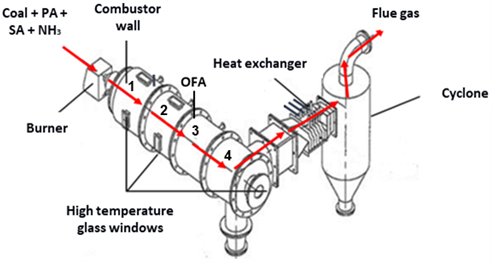
Hydrogen carriers, such as Ammonia (NH3), is anticipated to be used as a carbon-free alternative for solid fuels, such as coal. Hence, the effect of air staging ratio (ASR) on emissions from NH3 co-firing with sub-bituminous coal was numerically investigated in a small-scale coal combustor via a Large Eddy Simulation (LES) method. The validation with experimental data demonstrated a difference in nitrogen oxides (NOx) and temperature profiles of less than 10 %. Carbon dioxide (CO2) and sulphur dioxide (SO2) levels are decreasing as the NH3 percentage rises, but ASR has minimal influence. Increasing the ASR from 20 to 60 % resulted in NOx reduction, except for 60 calorific (cal.) % NH3, where NOx began to grow at ASR 60 %. In the said case, peak temperature was recorded in the over-fire Air (OFA) zone due to considerable unburned carbon (UC) oxidation, resulting in an increase in thermal NOx. Due to oxygen deficiency, coal volatiles and NH3 are thought to burn in the firing zone due to dominant devolatilization, resulting in significant UC/char oxidation in the OFA zone. Overall, with proper ASR tuning, NH3 co-firing can produce low CO2, SO2, and NOx, and existing coal-fired utility ASR technology can be used.
- Cesaro Z, Ives M, Nayak-Luke R, Mason M, Banares-Alcantara R. Ammonia to power: Forecasting the levelized cost of electricity from green ammonia in large-scale power plants. Appl Energy. 2021; https://doi.org/10.1016/j.apenergy.2020.116009
- Cardoso JS, Silva V, Chavando JAM, Eusebio D, Hall MJ. Numerical modelling of the coal phase-out through ammonia and biomass co-firing in a pilot-scale fluidized bed reactor. JFUECO. 2022; https://doi.org/10.1016/j.jfueco.2022.100055
- Zhang J, Ito T, Ishii H, Ishihara S, Fujimori T. Numerical investigation on ammonia co-firing in a pulverized coal combustion facility: Effect of ammonia co-firing ratio. Fuel. 2020; https://doi.org/10.1016/j.fuel.2020.117166
- Tsukada N, Kinoshita N, Kabuki Y, Taguchi Y, Takashima Y, Tsumura T, Taniguchi M. Role of OH Radical in Fuel-NOx Formation during Cocombustion of Ammonia with Hydrogen, Methane, Coal, and Biomass. Energy Fuels. 2020; https://dx.doi.org/10.1021/acs.energyfuels.0c00356
- Weng W, Li Zhongshan, Marshall P, Glarborg P. Participation of alkali and sulfur in ammonia combustion chemistry: Investigation for ammonia/solid fuel co-firing applications. Combust Flame. 2022; https://doi.org/10.1016/j.combustflame.2022.112236
- Chen P, Jiang B, Wang H, Gu M, Fang Y, Wang P. Experimental and theoretical calculations study on heterogeneous reduction of NO by char/NH3 in the reduction zone of ammonia co-firing with pulverized coal: Influence of mineral Fe. Fuel. 2022; https://doi.org/10.1016/j.fuel.2021.122374
- Ishihara S, Zhang J, Ito T. Numerical calculation with detailed chemistry on ammonia co-firing in a coal-fired boiler: Effect of ammonia co-firing ratio on NO emissions. Fuel. 2020; https://doi.org/10.1016/j.fuel.2020.117742
- Zhu J, Liu X, Xu Y, Xu J, Wang H, Zhang K, Cheng X, Yu D. Probing into Volatile Combustion Flame and Particulate Formation Behavior During the Coal and Ammonia Co-firing Process. Energy Fuels. 2021; https://doi.org/10.1021/acs.energyfuels.2c01450
- Wang X, Fan W, Chen J, Feng G, Zhang X. Experimental study and kinetic analysis of the impact of ammonia co-firing ratio on products formation characteristics in ammonia/coal co-firing process. Fuel. 2022; https://doi.org/10.1016/j.fuel.2022.125496
- Yuan T, Xu Y, Wang C, Gao P, Zhao P, Zhao L, Jin C, Li C, He B. Calculation of CO2 emissions from coal-fired power plants based on OCO-2/3 satellite observations and divergence model: Energy. 2025; https://doi.org/10.1016/j.energy.2024.134303
- Chen P, Fang Y, Wang P, Gu M, Luo K, Fan J. The effect of ammonia co-firing on NO heterogeneous reduction in the high-temperature reduction zone of coal air-staging combustion: Experimental and quantum chemistry study. Combust Flame. 2022; https://doi.org/10.1016/j.combustflame.2021.111857
- Ishihara S, Zhang J, Ito T. Numerical calculation with detailed chemistry of effect of ammonia co-firing on NO emissions in a coal-fired boiler. Fuel. 2020; https://doi.org/10.1016/j.fuel.2019.116924
- Rahman MN, Wahid MA. Renewable-based zero-carbon fuels for the use of power generation: A case study in Malaysia supported by updated developments worldwide. Energy Rep. 2021; https://doi.org/10.1016/j.egyr.2021.04.005
- Rahman MN, Ujir MH, Wahid MA, Yasin MFM. A single‑step chemistry mechanism for biogas supersonic combustion velocity with nitrogen dilution. J Therm Anal Calorim. 2022; https://doi.org/10.1007/s10973-022-11356-x
- Rahman MN, Shahril N, Yusup S. Hydrogen-Enriched Natural Gas Swirling Flame Characteristics: A Numerical Analysis. CFD Lett. 2022; https://doi.org/10.37934/cfdl.14.7.100112
- Chen P, Wang H, Jiang B, Wang Y, Gu M, Chen G, Huang X. An experimental and theoretical study of NO heterogeneous reduction in the reduction zone of ammonia co-firing in a coal-fired boiler: Influence of CO. Fuel Process Technol. 2022; https://doi.org/10.1016/j.fuproc.2022.107184
- Cardoso JS, Silva V, Eusebio D, Tarelho LAC, Hall MJ, Dana AG. Numerical modelling of ammonia-coal co-firing in a pilot-scale fluidized bed reactor: Influence of ammonia addition for emissions control. Energy Convers Manag. 2022; https://doi.org/10.1016/j.enconman.2022.115226
- Stocks M, Fazeli R, Hughes L, Beck FJ. Global emissions implications from co-combusting ammonia in coal fired power stations: An analysis of the Japan-Australia supply chain. J Clean Prod. 2022; https://doi.org/10.1016/j.jclepro.2021.130092
- Valera-Medina A, Xiao H, Owen-Jones M, David WIF, Bowen PJ. Ammonia for power. Prog Energy Combust Sci. 2018; https://doi.org/10.1016/j.pecs.2018.07.001
- Tamura M, Gotou T, Ishii H, Riechelmann D. Experimental investigation of ammonia combustion in a bench scale 1.2 MW-thermal pulverised coal firing furnace. Appl Energy. 2020; https://doi.org/10.1016/j.apenergy.2020.115580
- Ouyang Z, Liu W, Man C, Zhu J, Liu J. Experimental study on combustion, flame and NOX emission of pulverized coal preheated by a preheating burner. Fuel Process Technol. 2018; https://doi.org/10.1016/j.fuproc.2018.07.008
- Kim W, Lee D, Park S. Experimental study on optimization of over-fire air in modified combustion condition with selective catalytic reduction. J Mech Sci Technol. 2011; https://doi.org/10.1007/s12206-011-0208-3
- Lee H, Lee M. Recent Advances in Ammonia Combustion Technology in Thermal Power Generation System for Carbon Emission Reduction. Energies. 2021; https://doi.org/10.3390/en14185604
- Pestheruwe N, Huangwei Z, Lin M, Ruoyang Y. Numerical simulations on the combustion and emission characteristics of a non-premixed NH3/CH4 swirling flame using LES-FGM method. AIAA SCITECH Forum. 2023. https://doi.org/10.2514/6.2023-1722
- Dounia O, Vermorel O, Misdariis A, Poinsot T. Influence of kinetics on DDT simulations. Combustion and Flame. 2019. https://doi.org/10.1016/j.combustflame.2018.11.009
- Taamallah S, Vogiatzaki K, Alzahrani FM, Mokheimer EM, Habib MA, Ghoniem AF. Fuel flexibility, stability and emissions in premixed hydrogen-rich gas turbine combustion: Technology, fundamentals, and numerical simulations. Applied energy. 2015. https://doi.org/10.1016/j.apenergy.2015.04.044
- Meloni R, Nassini PC, Andreini A. Model development for the simulation of the hydrogen addition effect onto the NOx emission of an industrial combustor. Fuel. 2022. https://doi.org/10.1016/j.fuel.2022.125278
- Zheng K, Yu M, Liang Y, Zheng L, Wen X. Large eddy simulation of premixed hydrogen/methane/air flame propagation in a closed duct. International Journal of Hydrogen Energy. 2018. https://doi.org/10.1016/j.ijhydene.2018.01.045
- Rahman MN, Othman NF. A Numerical Model for Ash Deposition Based on Actual Operating Conditions of a 700 MW Coal-Fired Power Plant: Validation Feedback Loop via Structural Similarity Indexes (SSIMs). CFD Lett. 2022; https://doi.org/10.37934/cfdl.14.1.99111
- Rahman MN. Optimisation of Solid Fuel In-furnace Blending for an Opposed-firing Utility Boiler: A Numerical Analysis. CFD Lett. 2022; https://doi.org/10.37934/cfdl.14.9.89107
- Sun W, Zhong W, Echekki T. Large eddy simulation of non-premixed pulverized coal combustion in corner-fired furnace for various excess air ratios. Appl Math Model. 2019; https://doi.org/10.1016/j.apm.2019.05.017
- Wan K, Xia J, Wang Z, Pourkashanian M, Cen K. Large-eddy Simulation of Pilot-assisted Pulverized-coal Combustion in a Weakly Turbulent Jet. Flow Turbulence Combust. 2017; https://doi.org/10.1007/s10494-017-9817-y
- Sun W, Zhong W, Zhang J, Echekki T. Large Eddy Simulation on the Effects of Coal Particles Size on Turbulent Combustion Characteristics and NOx Formation Inside a Corner-Fired Furnace. J Energy Resour Technol. 2021; https://doi.org/10.1115/1.4048864
- Silva VB, João C. Computational fluid dynamics applied to waste to energy processes: a hands-on approach. Butterworth-Heinemann; 2020.
- Hu Y, Naito S, Kobayashi N, Hasatani M. CO2, NOx and SO2 emissions from the combustion of coal with high oxygen concentration gases. Fuel. 2000; https://doi.org/10.1016/S0016-2361(00)00047-8
- Askarova AS, Messerle VE, Ustimenko AB, Bolegenova SA, Maximov VY, Yergalieva AB. Reduction of noxious substance emissions at the pulverized fuel combustion in the combustor of the BKZ-160 boiler of the Almaty heat electropower station using the “Overfire Air” technology*. Thermophys Aeromechanics. 2016; https://doi.org/10.1134/S0869864316010133
- Speight JG. Coal-fired power generation handbook. John Wiley & Sons; 2021. ISBN: 978-1-119-51013-0
- Nagatani G, Ishii H, Ito K, Ohno E, Okuma Y. Development of Co-Firing Method of Pulverized Coal and Ammonia to Reduce Greenhouse Gas Emissions. IHI Engineering Review. 2020. https://www.ihi.co.jp/en/technology/sdgs/topic01/pdf/Vol53No1_F.pdf