Allocating currency risk in renewable power finance: tariff indexation, hedging, and sovereign guarantees
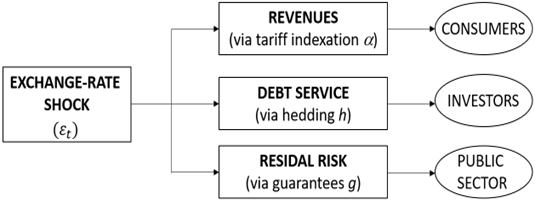
Emerging nations' renewable energy investments are frequently hampered by currency risk resulting from the mismatch between local-currency revenues and foreign-currency funding. Though financial hedging, tariff indexation, and sovereign guarantees are often employed to reduce this risk, present studies usually treat these tools separately. Under exchange-rate uncertainty, this study creates a single framework combining all three channels into a unified project-finance model of renewable energy investment. Key features of renewable energy finance are captured by the model, including long-term power purchase agreements, limited hedging markets, and government involvement through guarantees. It defines how, in equilibrium, tariff indexation, private hedging, and government guarantees interact to distribute currency risk among investors, consumers, and the public sector. The research reveals three major observations. Private hedging first reacts endogenously to governmental policy decisions; more indexation or guarantees crowd out financial risk management. Second, while financial hedging rules in deep markets prevail, tariff indexation is somewhat more successful in volatile settings. Third, while sovereign guarantees enhance project bankability, they could transfer risk to public balance sheets. The paper proposes a least-cost risk absorption principle and offers advice on creating currency-risk reduction plans that strike a compromise between fiscal sustainability and investment incentives.
- Hamid, I., Alam, M. S., & Kanwal, A. (2022). Decarbonization pathways: the roles of foreign direct investments, governance, democracy, economic growth, and renewable energy transition. Environ Sci Pollut Res, 29, 49816–49831. https://doi.org/10.1007/s11356-022-18935-3
- Aizenman, J., Jinjarak, Y., Park, D., & Zheng, H. (2021). Good-bye original sin, hello risk on-off, financial fragility, and crises? Journal of International Money and Finance, 117, 102442. https://doi.org/10.1016/j.jimonfin.2021.102442
- Bianchi, J., & Coulibaly, L. (2026). A theory of fear of floating. Journal of Monetary Economics, 157, 103869. https://doi.org/10.1016/j.jmoneco.2025.103869
- Obike, O., Soetanto, R., & Sohail, M. (2025). A risk management model for integrating resilience into renewable energy projects. Construction Management and Economics, 43(7), 537–555. https://doi.org/10.1080/01446193.2025.2477695
- Taghizadeh-Hesary, F., Yoshino, N., Rasoulinezhad, E., & Rimaud, C. (2021). Power purchase agreements with incremental tariffs in local currency: An innovative green finance tool. Global Finance Journal, 50, 100666. https://doi.org/10.1016/j.gfj.2021.100666
- Lessambo, F. I. (2022). International Project Finance: The Public-Private Partnership. Springer Nature. ISBN: 303096390X
- Jeanne, O.D., Zettelmeyer, J. (2002). Original sin, balance sheet crises, and the roles of international lending. IMF Working Papers, 2002:234, 27 pages. https://doi.org/10.5089/9781451875638.001
- Barnea, G., Hagemann, C., & Wurster, S. (2022). Policy instruments matter: Support schemes for renewable energy capacity in worldwide comparison. Energy Policy, 168, 113093. https://doi.org/10.1016/j.enpol.2022.113093
- Eichengreen, B., Hausmann, R., Panizza, U. (2005). The pain of original sin, in Other people's money : debt denomination and financial instability in emerging market economies. Chicago. The University of Chicago Press, ISBN 0-226-19455-8. p. 13-47.
- Kijek, T., Kijek, A., Bolibok, P., & Matras-Bolibok, A. (2021). The Patterns of Energy Innovation Convergence across European Countries. Energies, 14(10), 2755. https://doi.org/10.3390/en14102755
- Halkos, G. E., & Tsirivis, A. S. (2023). Electricity Prices in the European Union Region: The Role of Renewable Energy Sources, Key Economic Factors and Market Liberalization. Energies, 16(6), 2540. https://doi.org/10.3390/en16062540
- Besant-Jones, J.E. (2006). Reforming power markets in developing countries. What Have We Learned? The World Bank Group. Energy and Mining Sector Board. Paper No: 19.
- Ullah, S., & Nobanee, H. (2025). Decoding exchange rate in emerging economy: Financial and energy dynamics. Heliyon, 11(2), e41995. https://doi.org/10.1016/j.heliyon.2025.e41995
- Ihsan, H., Rashid, A., and Naz, A. (2018). Exchange Rate Exposure and Firm Value: An Assessment of Domestic Versus Multinational Firms. The Lahore Journal of Economics, 23:1, 51–77. https://doi.org/10.35536/lje.2018.v23.i1.A3
- Borio, C., Iqbal, M., McCauley, R., McGuire, P., Sushko, V. (2018). The failure of covered interest parity: FX hedging demand and costly balance sheets. BIS Working Papers, No 590. Bank for International Settlements. ISSN 1682-7678.
- Gill, D. J. (2021). Rethinking sovereign default. Review of International Political Economy, 28(6), 1751–1770. https://doi.org/10.1080/09692290.2021.1913439
- Irwin, T.C. (2007). Government Guarantees: Allocating and Valuing Risk in Privately Financed Infrastructure Projects. World Bank.ISBN-10: 0-8213-6859-1. https://doi.org/10.1596/978-0-8213-6858–9
- Abor, J.Y., Subramanian, L., Iddrisu, K., Nsor-Ambala, R. (2024). Multilateral Development Banks: Contributions and Challenges. In: Abor, J.Y., Ofori-Sasu, D. (eds) Perspectives on Development Banks in Africa. Palgrave Macmillan, Cham. https://doi.org/10.1007/978-3-031-59511-0_12
- Engel, E., Fischer, R.D., Galetovic, A. (2014). The Economics of Public-Private Partnerships: A Basic Guide. Cambridge University Press. ISBN: 9781139565615. https://doi.org/10.1017/CBO9781139565615
- Saxena, S. (2022). How to Manage Fiscal Risks from Subnational Governments. IMF How To Notes, 29. ISBN: 9798400216831.
- Hepburn, C., O’Callaghan, B., Stern, N., Stiglitz, J., Zenghelis, D. (2020). Will COVID-19 fiscal recovery packages accelerate or retard climate change? Oxford Review of Economic Policy, 36(S1), S359–S381. https://doi.org/10.1093/oxrep/graa015
- Esty, B.C. (2004), Why Study Large Projects? An Introduction to Research on Project Finance. European Financial Management, 10: 213-224. https://doi.org/10.1111/j.1354-7798.2004.00247.x
- Yescombe, E.R. (2014). Principles of Project Finance (2nd ed.). Academic Press. ISBN 978-0-12-391058-5. https://doi.org/10.1016/C2011-0-04268-0
- Wójcik-Czerniawska, A. (2023). International Capital Flows and Monetary Policy in the Emerging Economies. In: Demir, E., Bilgin, M.H., Danis, H., D'Ascenzo, F. (eds) Eurasian Business and Economics Perspectives. EBES 2022. Eurasian Studies in Business and Economics, vol 26. Springer, Cham. https://doi.org/10.1007/978-3-031-30061-5_29
- Van Doornik, B. F. N., Frost, J., Guerra, R., Tombini, A., & Upper, C. (2024). Towards liquid and resilient government debt markets in EMEs. BIS Quarterly Review, March 2024. https://www.bis.org/publ/qtrpdf/r_qt2403e.htm, Accessed on 01/19/2026.
- Kadırgan, C. (2023). Exchange rate driven balance sheet effect and capital flows to emerging market economies. The Quarterly Review of Economics and Finance, 87, 35–45. https://doi.org/10.1016/j.qref.2022.11.003
- Contractor, F. (2025). Assessing the economic impact of tariffs: adaptations by multinationals and traders to mitigate tariffs. Review of International Business and Strategy, 35(2–3), 190–213. https://doi.org/https://doi.org/10.1108/RIBS-01-2025-0013
- IEA (2021), Financing Clean Energy Transitions in Emerging and Developing Economies, IEA, Paris https://www.iea.org/reports/financing-clean-energy-transitions-in-emerging-and-developing-economies, Licence: CC BY 4.0. Accessed on 01/17/2026.
- Egli, F. (2020). Renewable energy investment risk: An investigation of changes over time and the underlying drivers. Energy Policy. 140. 111428. https://doi.org/10.1016/j.enpol.2020.111428