A low-order dynamical model for delayed thermal drawdown in subsurface energy systems

Downloads
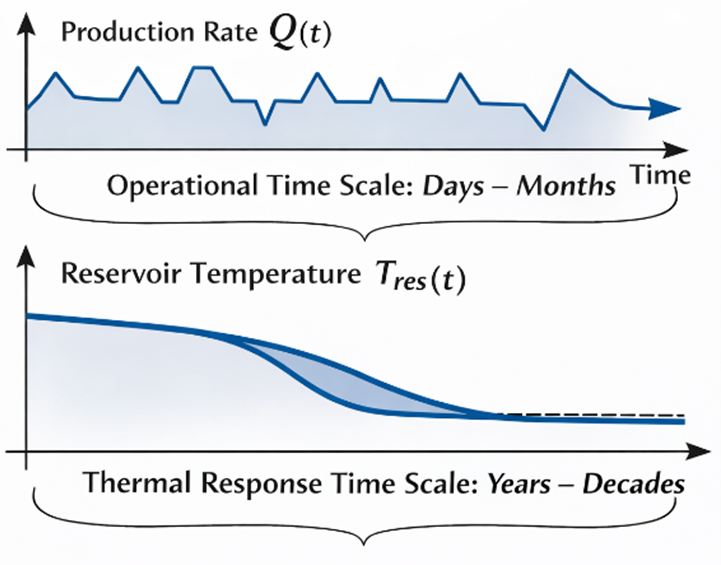
Long-term thermal drawdown is a fundamental constraint on the sustainability of subsurface thermal energy systems, yet its onset often does not become apparent for several decades after exploitation begins due to large thermal inertia and slow heat transport processes. This delayed response complicates sustainability assessment and may lead to overestimation of system longevity when early operational data are used. Although high-fidelity numerical simulators can capture delayed thermal behavior, their computational cost and limited interpretability restrict their usefulness for rapid, conceptual analysis at the system level. This study presents a simplified low-order dynamical model to examine delayed thermal drawdown in subsurface energy systems, with geothermal reservoirs considered as a primary application. The system is represented by a lumped thermal state driven by heat extraction and gradual geothermal recharge, with an explicit time-delay term introduced to account for geological memory and delayed thermal response. Analytical and numerical investigations using synthetic production scenarios show that significant thermal drawdown emerges only when production history changes, explaining prolonged early-stage stability followed by later temperature decline. The proposed framework is intended as a screening-level and educational tool that complements high-fidelity numerical simulations and supports long-term management of thermal energy systems.
Kassem, M.A., Moscariello, A. (2025). Geothermal energy: A sustainable and cost-effective alternative for clean energy production and climate change mitigation, Sustainable Futures, 10, 101247. https://doi.org/10.1016/j.sftr.2025.101247.
de Bruijn, E.A.M., Bloemendal, M., ter Borgh, M.M., Godderij, R.R.G.G. , Vossepoel, F.C. (2021). Quantifying the contribution of heat recharge from confining layers to geothermal resources, Geothermics, 93, 102072. https://doi.org/10.1016/j.geothermics.2021.102072.
White, M., Vasyliv, Y., Beckers, K., Martinez, M., Balestra, P., Parisi, C., Augustine, C., Bran-Anleu, G., Horne, R., Pauley, L., Bettin, G., Marshall, T., Bernat, A. (2024). Numerical investigation of closed-loop geothermal systems in deep geothermal reservoirs, Geothermics,116, 102852. https://doi.org/10.1016/j.geothermics.2023.102852.
Reimus, P., Caporuscio, F., Marina, O., Janney, D. (2020). Field demonstration of the combined use of thermally-degrading and cation-exchanging tracers to predict thermal drawdown in a geothermal reservoir, Geothermics, 83, 101712, https://doi.org/10.1016/j.geothermics.2019.101712.
Haklıdır, F.S.T. (2020). The importance of long-term well management in geothermal power systems using fuzzy control: A Western Anatolia (Turkey) case study, Energy, 213, 118817, https://doi.org/10.1016/j.energy.2020.118817.
Gao, X., Li, T., Zhang, Y., Kong, X., & Meng, N. (2022). A Review of Simulation Models of Heat Extraction for a Geothermal Reservoir in an Enhanced Geothermal System. Energies, 15(19), 7148. https://doi.org/10.3390/en15197148.
Franco, A., & Vaccaro, M. (2014). Numerical simulation of geothermal reservoirs for the sustainable design of energy plants: A review. Renewable & Sustainable Energy Reviews, 30, 987–1002. https://doi.org/10.1016/J.RSER.2013.11.041.
Fitzgerald, S. D., & Woods, A. W. (1998). Instabilities during liquid migration into superheated geothermal reservoirs. Water Resources Research, 34(9), 2089–2101. https://doi.org/10.1029/98WR01448.
Zeedan, A., Abd, A., & Abushaikha, A. S. (2025). Reservoir Simulations: A Comparative Review of Machine Learning Approaches. IEEE Access, 1. https://doi.org/10.1109/access.2025.3614017.
Barbier, E. (1997). Nature and technology of geothermal energy: A review. Renewable and Sustainable Energy Reviews, 1(1–2), 1–69. https://doi.org/10.1016/S1364-0321(97)00001-4.
Qin, Z., Qin, Z., Valfells, A., & Guðjónsdóttir, M. S. (2017). The lumped-parameter model on two-phase and superheated geothermal reservoir. Energy Procedia, 142, 481–487. https://doi.org/10.1016/J.EGYPRO.2017.12.075.
Omrani, P.S., Egberts, P. J. P., Rijnaarts, H. H. M., & Shariat Torbaghan, S. (2026). Geothermal plant operation and control under demand uncertainties. Renewable Energy, 257, 124805. https://doi.org/10.1016/j.renene.2025.124805.
Fan, R., Jiang, Y., Yao, Y., Shiming, D., & Ma, Z. (2007). A study on the performance of a geothermal heat exchanger under coupled heat conduction and groundwater advection. Energy, 32(11), 2199–2209. https://doi.org/10.1016/j.energy.2007.05.001.
Millstein, D., Dobson, P., & Jeong, S. (2021). The Potential to Improve the Value of U.S. Geothermal Electricity Generation Through Flexible Operations Open Access. J. Energy Resour. Technol., 143(1), 010905. https://doi.org/10.1115/1.4048981.
Ostermann, I. (2011). Three-dimensional modeling of heat transport in deep hydrothermal reservoirs. Gem - International Journal on Geomathematics, 2(1), 37–68. https://doi.org/10.1007/S13137-011-0017-Y.
Pandey, S. N., & Singh, M. (2021). Artificial Neural Network to Predict the Thermal Drawdown of Enhanced Geothermal System Available to Purchase. J. Energy Resour. Technol., 143(1), 010901. https://doi.org/10.1115/1.4048067.
Abdullah, F., Wu, Z., & Christofides, P. D. (2021). Data-based reduced-order modeling of nonlinear two-time-scale processes. Chemical Engineering Research and Design, 166, 1–9. https://doi.org/10.1016/j.cherd.2020.11.009.
Liu, PH., & Lin, JC. (2025). Integrated risk assessment and mitigation strategies for geothermal energy development: technical, socio-political, and financial dimensions. Sustainable Energy Res., 12, 64. https://doi.org/10.1186/s40807-025-00218-3.
Liu, S., Chai, J., Liu, J., & Xue, Y. (2024). Effect of water-cooling shock on heat production performance of enhanced geothermal systems. Energy Sources, Part A: Recovery, Utilization, and Environmental Effects, 46(1), 559–577. https://doi.org/10.1080/15567036.2023.2284843.
Yang, F., Wang, G., Hu, D., Zhou, H., & Tan, X. (2022). Influence of water-rock interaction on permeability and heat conductivity of granite under high temperature and pressure conditions. Geothermics, 100, 102347. https://doi.org/10.1016/j.geothermics.2022.102347.
Ciriello, V., Bottarelli, M., Di Federico, V., & Tartakovsky, D. M. (2015). Temperature fields induced by geothermal devices. Energy, 93(Part 2), 1896–1903. https://doi.org/10.1016/j.energy.2015.10.052.
Bagalkot, N., & Kumar, G. S. (2015). Thermal front propagation in variable aperture fracture–matrix system: A numerical study. Sadhana, 40, 605–622. https://doi.org/10.1007/s12046-014-0324-8.
Heinze, T., Hamidi, S., & Galvan, B. (2017). A dynamic heat transfer coefficient between fractured rock and flowing fluid. Geothermics, 65, 10–16. https://doi.org/10.1016/j.geothermics.2016.08.007.
Khan, Z. H., Zhou, M., Trounev, A., & Khan, W. A. (2025). Modeling liquid–vapor fronts in porous media using time-fractional derivatives: An innovative framework. Physics of Fluids, 37, 032112. https://doi.org/10.1063/5.0259241.
Gan, Q., & Elsworth, D. (2014). Analysis of fluid injection-induced fault reactivation and seismic slip in geothermal reservoirs. J. Geophys. Res. Solid Earth, 119, 3340–3353. https://doi.org/10.1002/2013JB010679.
Sarak, H., Onur, M., & Satman, A. (2005). Lumped-parameter models for low-temperature geothermal fields and their application. Geothermics, 34(6), 728–755. https://doi.org/10.1016/j.geothermics.2005.09.001.
Singh, M., Mahmoodpour, S., Schmidt-Hattenberger, C., Sass, I., & Drews, M. (2024). Influence of Reservoir Heterogeneity on Simultaneous Geothermal Energy Extraction and CO2 Storage. Sustainability, 16(1), 387. https://doi.org/10.3390/su16010387.
Mudunuru, M. K., Karra, S., Harp, D. R., Guthrie, G. D., & Viswanathan, H. S. (2017). Regression-based reduced-order models to predict transient thermal output for enhanced geothermal systems. Geothermics, 70, 192–205. https://doi.org/10.1016/j.geothermics.2017.06.013.
Bujakowski, W., Tomaszewska, B., & Miecznik, M. (2016). The Podhale geothermal reservoir simulation for long-term sustainable production. Renewable Energy, 99, 420–430. https://doi.org/10.1016/j.renene.2016.07.028.
Goodwin, N., May, M., Wilson, S., & Graham, G. (2020). Mineral Solubility Measurement and Prediction Under High Pressure, High Temperature Reservoir Conditions. https://doi.org/10.2118/199285-MS.
Steingrimsson, B., Bodvarsson, G. S., Cuellar, G., & Escobar, C. (1989). Changes in thermodynamic conditions of the Ahuachapan reservoir due to production and injection. https://digital.library.unt.edu/ark:/67531/metadc1198144/m2/1/high_res_d/6680654.pdf.
Mégel, T., & Rybach, L. (2000). Production capacity and sustainability of geothermal doublets. Proceedings World Geothermal Congress 2000. Kyushu - Tohoku, Japan, May 28 - June 10, 2000
Chevarunotai, N., Hasan, A. R., Kabir, C. S., & Islam, R. (2018). Transient flowing-fluid temperature modeling in reservoirs with large drawdowns. Journal of Petroleum Exploration and Production Technology, 8(3), 799–811. https://doi.org/https://doi.org/10.1007/s13202-017-0397-0.
Hermanns, M., & Pérez, J. M. (2014). Asymptotic Analysis of Vertical Geothermal Boreholes in the Limit of Slowly Varying Heat Injection Rates. Siam Journal on Applied Mathematics, 74(1), 60–82. https://doi.org/10.1137/130930170.
Maar, L., & Seifermann, S. (2023). Assessing the Environmental Sustainability of Deep Geothermal Heat Plants. Energies, 16(19), 6774. https://doi.org/10.3390/en16196774.
Wang, Y., Karimi, H. R., & Xiang, Z. (2013). Delay-Dependent Control for Networked Control Systems with Large Delays. Mathematical Problems in Engineering, 2013, 1–10. https://doi.org/10.1155/2013/643174.
Yang, Y., Fu, G., Zhao, J., & Gu, L. (2023). Heat Production Capacity Simulation and Parameter Sensitivity Analysis in the Process of Thermal Reservoir Development. Energies. https://doi.org/10.3390/en16217258.
Sekar, L. K., & Okoroafor, E. R. (2024). Maximizing Geothermal Energy Recovery from Enhanced Geothermal Systems Through Huff-And-Puff: A Comprehensive Simulation Study. https://doi.org/10.56952/arma-2024-0177.
Gan, Q., & Elsworth, D. (2014). Thermal drawdown and late-stage seismic-slip fault reactivation in enhanced geothermal reservoirs. Journal of Geophysical Research, 119(12), 8936–8949. https://doi.org/10.1002/2014JB011323.
Kikuchi, C. P., & Ferré, T. P. A. (2017). Analysis of subsurface temperature data to quantify groundwater recharge rates in a closed Altiplano basin, northern Chile. Hydrogeology Journal, 25(1), 103–121. https://doi.org/10.1007/S10040-016-1472-1.
Gu, X., Makasis, N., Motamedi, Y., Narsilio, G. A., Arulrajah, A., & Horpibulsuk, S. (2021). Geothermal pavements: field observations, numerical modelling and long-term performance. Geotechnique, 72(9), 832–846. https://doi.org/10.1680/jgeot.20.P.296.
Gudala, M., Tariq, Z., Govindarajan, S., Yan, B., & Sun, S. (2024). Fractured Geothermal Reservoir Using CO2 as Geofluid: Numerical Analysis and Machine Learning Modeling. ACS Omega. https://doi.org/10.1021/acsomega.3c07215.
De Simone, S., De Simone, S., Vilarrasa, V., Vilarrasa, V., Carrera, J., Alcolea, A., & Meier, P. M. (2013). Thermal coupling may control mechanical stability of geothermal reservoirs during cold water injection. Physics and Chemistry of The Earth, 64, 117–126. https://doi.org/10.1016/J.PCE.2013.01.001.
Pinyol, N. M., Alonso, E., Corominas, J., & Moya, J. (2012). Canelles landslide: modelling rapid drawdown and fast potential sliding. Landslides, 9(1), 33–51. https://doi.org/10.1007/S10346-011-0264-X.
Magicho, D. O., & Kwasira, J. (2025). Risk Dynamics and Performance of Geothermal Drilling Projects in Menengai, Nakuru County, Kenya. International Journal of Social Science and Humanities Research, 3(2). https://doi.org/10.61108/ijsshr.v3i2.207.
Li, M., Zhang, S., Zhao, Y., Cai, Y., Zhang, M., Liu, Z., Li, P., Wang, B., Xu, B., Shen, J., & Feng, B. (2025). Multifactor Coupling Effects on Permeability Evolution During Reinjection in Sandstone Geothermal Reservoirs: Insights from Dynamic Core Flow Experiments. Energies, 18(17), 4770. https://doi.org/10.3390/en18174770.
Hamid, O., & Abdalrahman, E. M. (2024). Renewable Management Strategies for Geothermal Energy Reservoirs. https://doi.org/10.56952/igs-2024-0872.
Robinson, B., Cohen, J. S., & Herman, J. D. (2020). Detecting early warning signals of long-term water supply vulnerability using machine learning. Environmental Modelling and Software, 131, 104781. https://doi.org/10.1016/J.ENVSOFT.2020.104781.
Podgorney, R., Huang, H., Plummer, M., & Gaston, D. (2013). A Globally-Implicit Computational Framework for Physics-based Simulation of Coupled Thermo-Hydro-Mechanical Problems: Application to Sustainability of Geothermal Reservoirs. 23(1), 51–58. https://doi.org/10.11128/SNE.23.TN.10175.
Pasetto, D., Pasetto, D., Guadagnini, A., & Putti, M. (2014). A reduced-order model for Monte Carlo simulations of stochastic groundwater flow. Computational Geosciences, 18(2), 157–169. https://doi.org/10.1007/S10596-013-9389-4.
Marino, R., Giambagli, L., Chicchi, L., Buffoni, L., & Fanelli, D. (2023). A Bridge between Dynamical Systems and Machine Learning: Engineered Ordinary Differential Equations as Classification Algorithm (EODECA). arXiv.Org, abs/2311.10387. https://doi.org/10.48550/arxiv.2311.10387.
Zhang, G. Y. (2024). Optimizing high-temperature geothermal extraction through THM coupling: insights from SC-CO2 enhanced modeling. Engineering Computations. https://doi.org/10.1108/ec-11-2023-0889.
Muqtadir, A., Zhang, B., Ben Saleh, W., Chalaturnyk, R., Vaisblat, N., Wigston, A., Drobot, A., Groenewoud, L., & Kirsten, M. (2025). Geothermal reservoir modeling and calibration in a coupled thermo-hydro-mechanical perspective - a case study for DEEP Geothermal Project in Saskatchewan, Canada. 59th U.S. Rock Mechanics/Geomechanics Symposium. https://doi.org/10.56952/ARMA-2025-0617.
Pyrcz, M. J., & White, C. D. (2015). Uncertainty in reservoir modeling. Interpretation, 3(2). https://doi.org/10.1190/INT-2014-0126.1.
Noye, S., Mulero Martinez, R., Carnieletto, L., De Carli, M., & Castelruiz Aguirre, A. (2022). A review of advanced ground source heat pump control: Artificial intelligence for autonomous and adaptive control. Renewable & Sustainable Energy Reviews, 153, 111685. https://doi.org/10.1016/J.RSER.2021.111685.